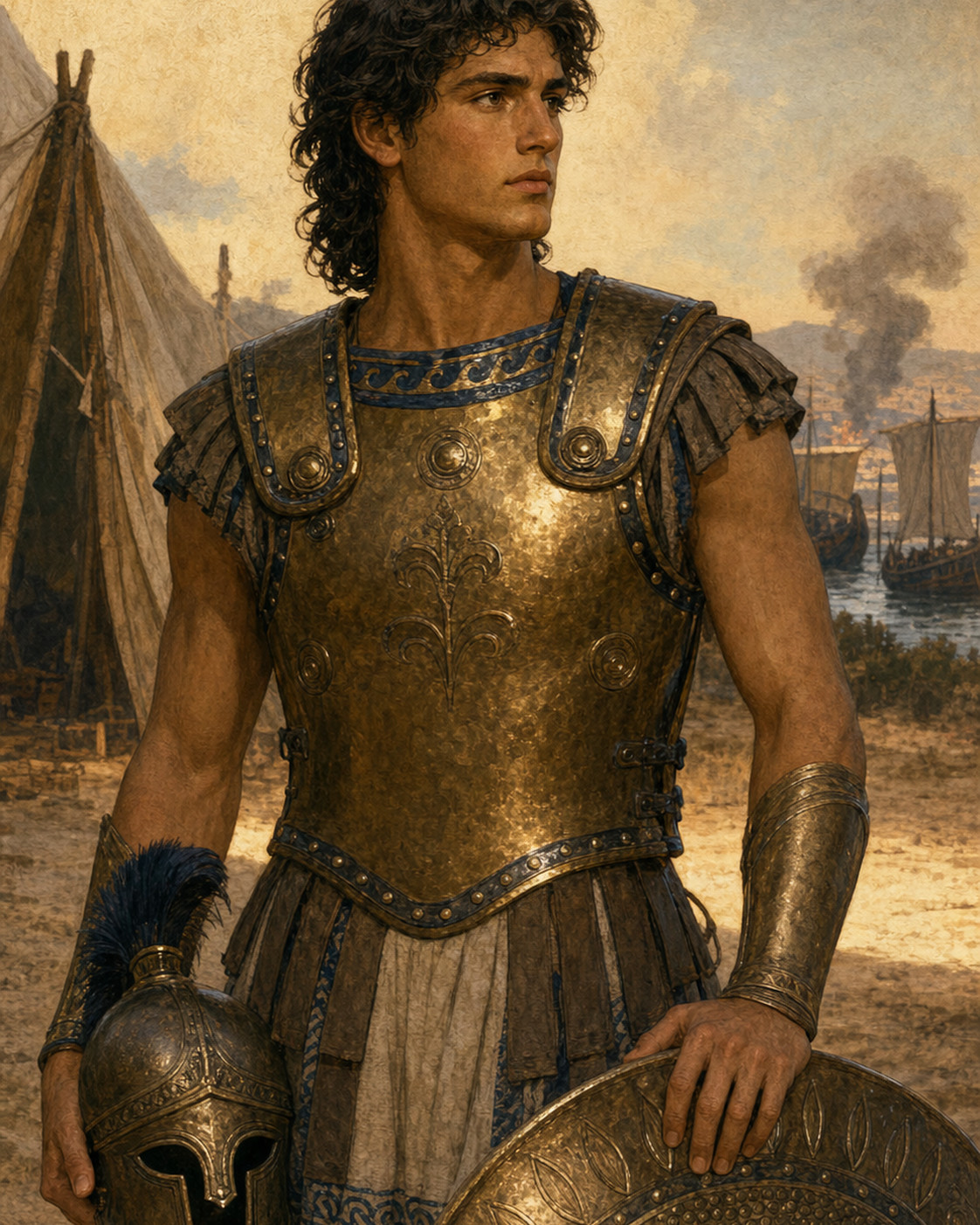
The wife and mother whose farewell to Hector reveals the future hidden behind heroic duty.
- Astyanax
- Captivity
- Hector
- Priam
- Scaean Gate
- Troy
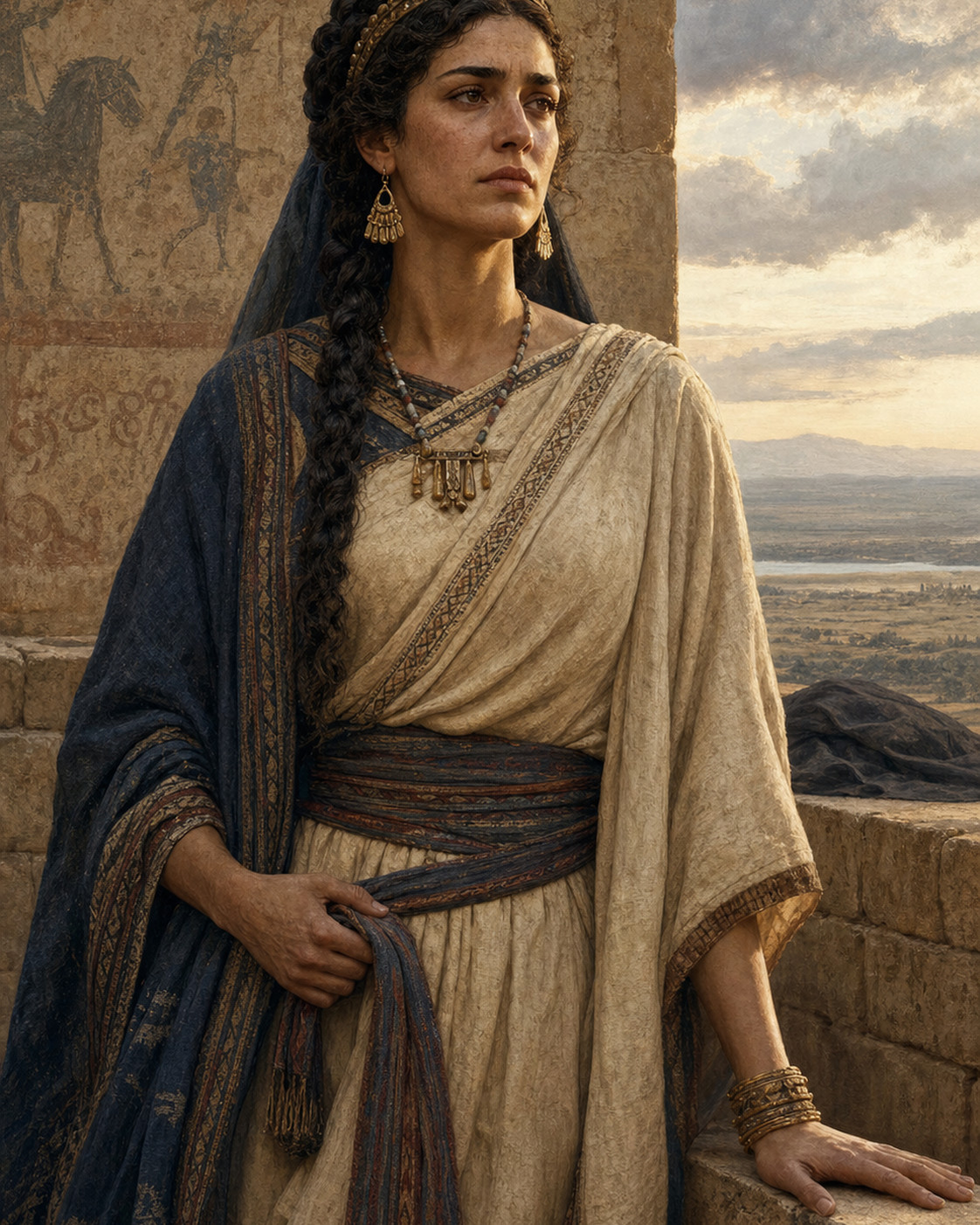
Andromache warns Hector at the Scaean Gate, laments him after Priam recovers the body, and survives Troy's fall only through captivity and displacement in later traditions.
Greek Mythology Timeline
Move through broad mythic ages and open the events that connect one story to the next. The sequence is a reading path, not an exact historical calendar.
Andromache is the wife of Hector, mother of Astyanax, and one of the clearest voices for the civilian cost of the Trojan War. Daughter of Eetion of Thebe under Placus, she has already lost her birth family to Achilles when she meets Hector at the Scaean Gate. Her warning, farewell, lament, enslavement, and later survival connect the heroic defense of Troy to the lives that continue after warriors receive their funerals.
Daughter of a Destroyed House
Andromache tells Hector that Achilles killed her father Eetion and seven brothers, while her mother died after ransom and release. By the time Troy faces its final crisis, she has made Hector her remaining father, mother, brother, and husband in one person.
The speech explains why another battlefield loss would be total rather than symbolic. Marriage has not simply moved her between two secure dynasties. War has erased the first household and placed the second under siege.
At the Scaean Gate
She runs to the wall after hearing the Trojans are pressed and meets Hector with their child and a nurse. Andromache asks him to defend from a safer position near a vulnerable section of wall rather than return to open combat.
Her advice is emotionally urgent but also tactical. The scene does not oppose irrational wife to rational warrior. It shows two kinds of knowledge: Hector understands public shame and army morale, while Andromache understands terrain, accumulated loss, and the future his death will create.
The Frightened Child
Astyanax recoils from Hector’s bronze and horsehair-crested helmet. His parents laugh, and Hector removes it before lifting the child and praying that he will become a greater defender of Troy.
The domestic pause makes martial identity visible as costume. What reassures an army frightens an infant. The prayer for inherited glory is loving, but the audience knows that the city and child will not receive the future Hector imagines.
Foreknowledge of Enslavement
Hector says he expects Troy to fall and imagines Andromache carried away to labor for another household. His greatest pain is not his own death but hearing that a captive woman was once Hector’s wife.
The prophecy exposes what heroic defeat means for women: loss of freedom, kin, status, home, and control over children. Andromache’s future is not an appendix after battle. It is one of the outcomes battle produces.
Hector’s Body Returns
After Priam ransoms Hector, Andromache leads the first extended lament over the body. She speaks of widowhood, Astyanax’s vulnerability, and the city left without its defender. Her grief interprets his public role through private consequences.
The Iliad ends with the funeral before Troy’s destruction. Andromache’s lament nevertheless looks beyond the poem’s final line, keeping the coming sack present without depicting it.
Captivity after Troy
Epic Cycle and tragic traditions make Astyanax a victim of the sack and assign Andromache to Neoptolemus, Achilles’ son. Euripides explores the humiliation and danger of a Trojan royal woman made captive in the victor’s household.
Different accounts describe her later children, conflict with Hermione, and movement to Epirus. These traditions are not Homeric scenes, but they answer the farewell’s question: survival may continue through coercion, relocation, and a new family that does not erase the first.
Memory and New Foundations
In Virgil’s Aeneid, Andromache appears in Epirus at a settlement that imitates parts of Troy. She tends a memorial for Hector and meets Aeneas, creating a poignant encounter between survivors who rebuild memory differently.
This Roman development lies outside Greek epic but became central to her later image. The copy of Troy cannot be the lost city, yet ritual, names, and architecture allow displaced people to organize grief into place.
Reading the Traditions
Andromache moves across genres: Homer gives farewell and lament, tragedy gives captivity and conflict, and Roman epic gives memorial survival. Each stage answers a different question, so they should form a labeled sequence rather than a seamless biography pretending one author knew every later episode.
Visual traditions likewise select different moments: the helmet frightening Astyanax, Andromache reaching toward Hector, the body returned to Troy, the child threatened at the sack, or the captive woman in a foreign household. Each image changes her role from counselor to mourner to survivor. Keeping the scene label visible prevents one powerful composition from standing for her entire life.
Her story also corrects a victory-centered map of the war. A route that ends when the horse enters Troy misses the households redistributed by conquest, the labor imposed on captives, and the ways displaced people carry names and ritual into new landscapes. Andromache gives those consequences a continuous human perspective.
That perspective makes her essential to any account that treats survival as history rather than an epilogue. She remembers both her birth house and Hector’s house, linking two communities destroyed in different phases of the same heroic world.
Follow her toward Hector for the farewell, Priam for the household that loses its sons, Helen for another Trojan woman’s contested position, Troy for home and ruin, and the Trojan War for the lives that continue after heroic fame ends.
Trivia
- Andromache’s name is commonly interpreted in relation to men or battle.
- Her farewell to Hector occurs in Iliad Book 6.
- Later tragedy makes her a captive of Neoptolemus after Troy falls.