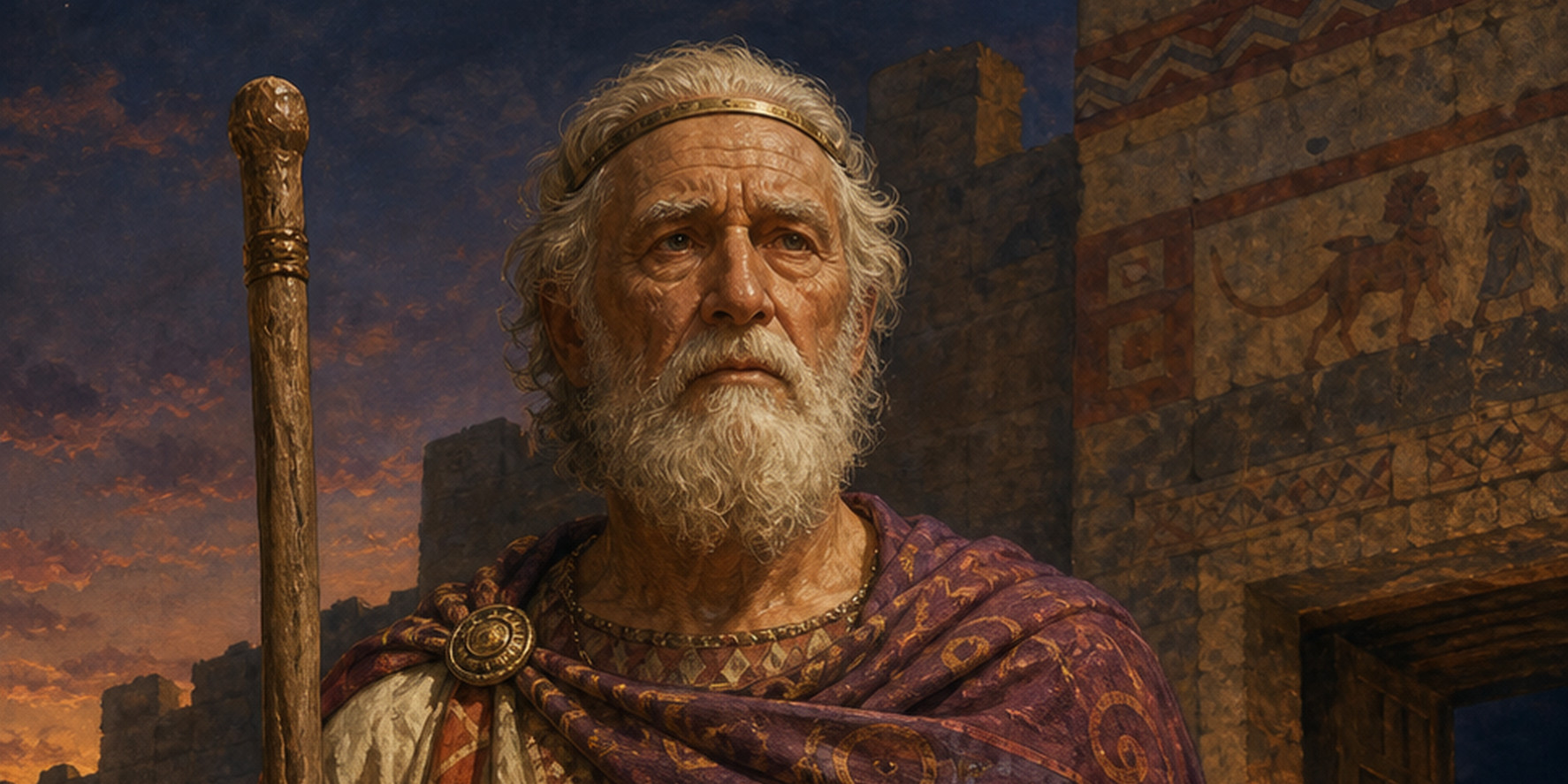
The old king who crosses the enemy camp with ransom and turns royal grief into the Iliad's final act of courage.
- Andromache
- Hector
- Helen
- Paris
- Ransom
- Troy
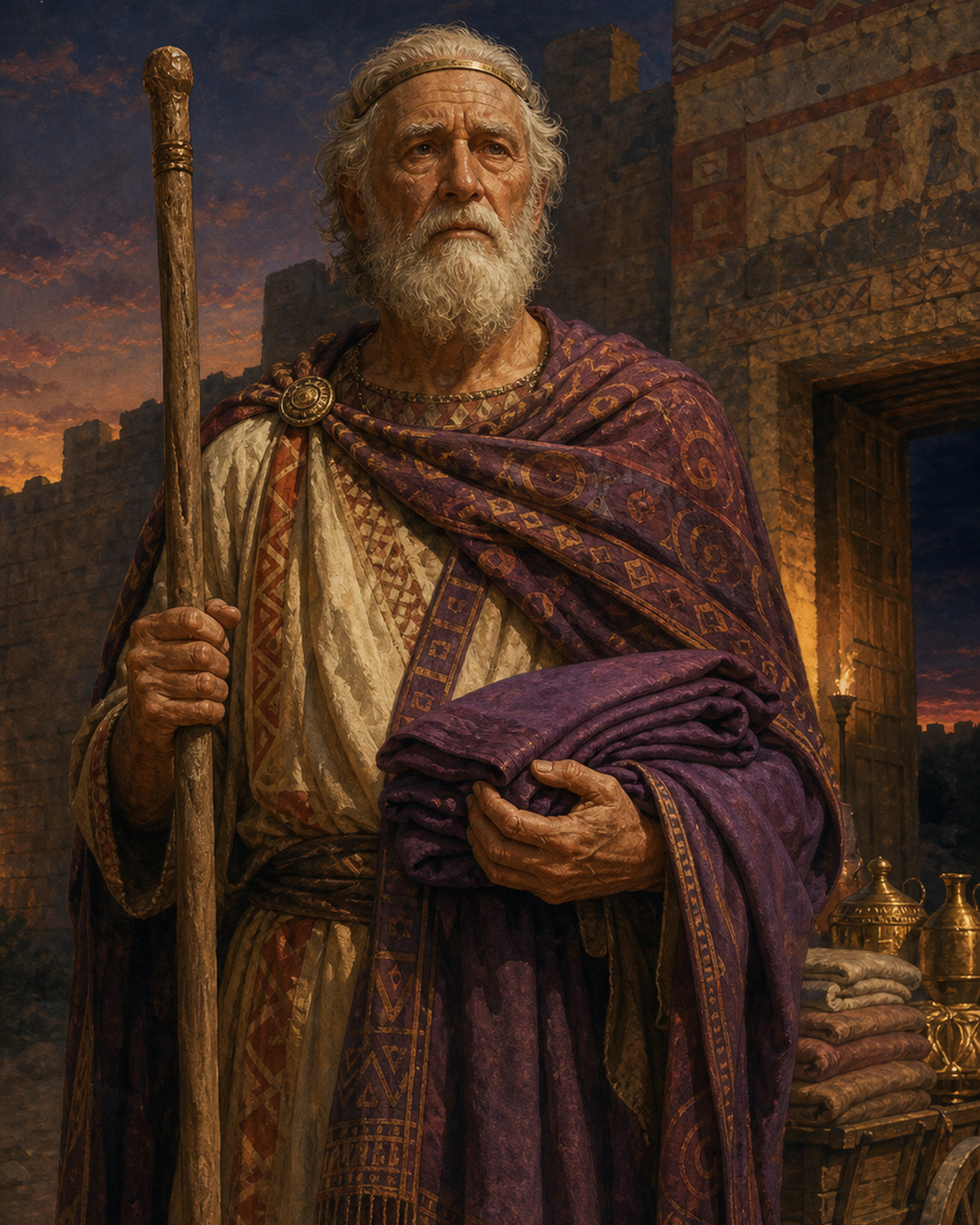
Priam rules Troy through the long siege, loses many children, and enters Achilles' hut under Hermes' guidance to ransom Hector. His appeal to shared fatherhood restores the body and makes burial possible.
Greek Mythology Timeline
Move through broad mythic ages and open the events that connect one story to the next. The sequence is a reading path, not an exact historical calendar.
Priam is the elderly king of Troy whose vast royal household is reduced by the war and whose journey to ransom Hector becomes the Iliad’s final great act of courage. Father of Hector, Paris, Cassandra, and many other children, he is wealthy and politically important, yet his most powerful scene strips kingship down to an unarmed parent kneeling before the man who killed his son.
King of a Large House
Priam rules a city connected to allies across Anatolia and the surrounding regions. The Iliad presents a palace crowded with sons, daughters, spouses, and children, making Troy’s royal house a political network as well as a family.
Ancient catalogues disagree about the exact number and names of his children. The abundance matters more than one fixed count: war destroys the future of a dynasty that once appeared exceptionally fertile and secure.
From Podarces to Priam
Later tradition says he was born Podarces and survived Heracles’ earlier sack of Troy when his sister Hesione redeemed him with a veil. His new name was connected with being purchased or ransomed.
This story precedes the Homeric war and is not required to understand Iliad 24, but it gives ransom a dynastic echo. The king who once survived through a relative’s payment later carries wealth to recover a son’s body.
Paris and the War
Priam receives Paris back into the royal house and does not surrender Helen when the Achaeans demand restoration. Sources distribute these decisions differently, and the elderly king of the Iliad inherits a conflict whose opening belongs mostly outside its action.
He treats Helen with notable kindness at the wall, refusing to blame her alone for the war. That courtesy contrasts with the destruction surrounding them and shows a ruler capable of separating a vulnerable person from the simplified cause assigned to her.
Watching the Duel
Priam joins Helen at the wall to identify Achaean leaders, then leaves before Paris and Menelaus fight. He says he cannot bear to watch his son face the husband whose marriage stands behind the conflict.
The withdrawal marks a limit to royal spectatorship. Priam can ratify oaths and command ritual, but fatherhood makes the duel personally intolerable.
Loss of Hector
When Achilles approaches, Priam and Hecuba beg Hector to come inside. Hector remains, is killed, and has his body dragged before the city. Priam’s authority cannot command the son on whom Troy depends.
The king then faces a different task. He cannot reverse the duel or save the city, but he can seek the body needed for funeral rites and communal mourning.
The Night Journey
Zeus sends Iris with instructions, and Hermes guides Priam through the Achaean camp. He travels with a herald and ransom rather than an army. The enemy space that no Trojan force can penetrate is crossed through divine escort, age, ritual vulnerability, and purpose.
Hecuba fears a trap, but Priam accepts the danger. The journey is heroic without battlefield violence: courage means approaching a stronger enemy while refusing the protection of rank and weapons.
Kissing the Killer’s Hands
Priam kneels before Achilles, kisses the hands that killed his sons, and asks him to remember Peleus. The appeal does not claim that Hector and Achilles were morally identical. It creates recognition through the shared condition of fathers and sons separated by war and death.
Achilles and Priam weep together, eat, arrange a truce for burial, and restore the body. The exchange turns ransom into more than purchase. It briefly reestablishes hospitality, limit, and human likeness inside a conflict built on their failure.
Death at the Sack
The Iliad ends before Priam’s death. Epic Cycle, tragedy, and later art place him at an altar during Troy’s sack, where Neoptolemus kills him after or near the death of another son.
That ending destroys the sanctuary and reciprocity achieved in Achilles’ hut. It belongs to later stages of the cycle and should not be inserted into Homer’s conclusion as though the poem narrates it.
Reading the Traditions
Priam’s central Homeric identity is built through speech, ritual, hospitality, grief, and ransom. Mythographic genealogy and sack narratives expand his life in both directions. Keeping those frames visible lets readers see why Iliad 24 can end with restored burial even when tradition knows that Troy will soon be destroyed.
The ransom scene also resists a simple division between victorious hero and defeated king. Priam enters without military leverage, yet controls the purpose of the encounter through ritual speech, gifts, memory, and the demand for burial. Achilles remains physically dominant while accepting a limit that force alone could never establish.
Later art repeatedly shows the old king at Achilles’ knees or beside Hector’s body. These images condense a long negotiation into touch and gaze. They are most accurate when the ransom goods, meal, truce, and preparation of the corpse remain part of the scene’s moral structure rather than decorative background.
Follow him toward Hector for the recovered body, Achilles for shared mourning, Paris and Helen for the war’s cause, Andromache for the threatened family, Troy for the royal city, and the Trojan War for a king’s diminishing field of action.
Trivia
- Priam travels to Achilles’ hut under Hermes’ guidance.
- He asks Achilles to remember his own father, Peleus.
- The Iliad ends after Priam brings Hector home for burial.