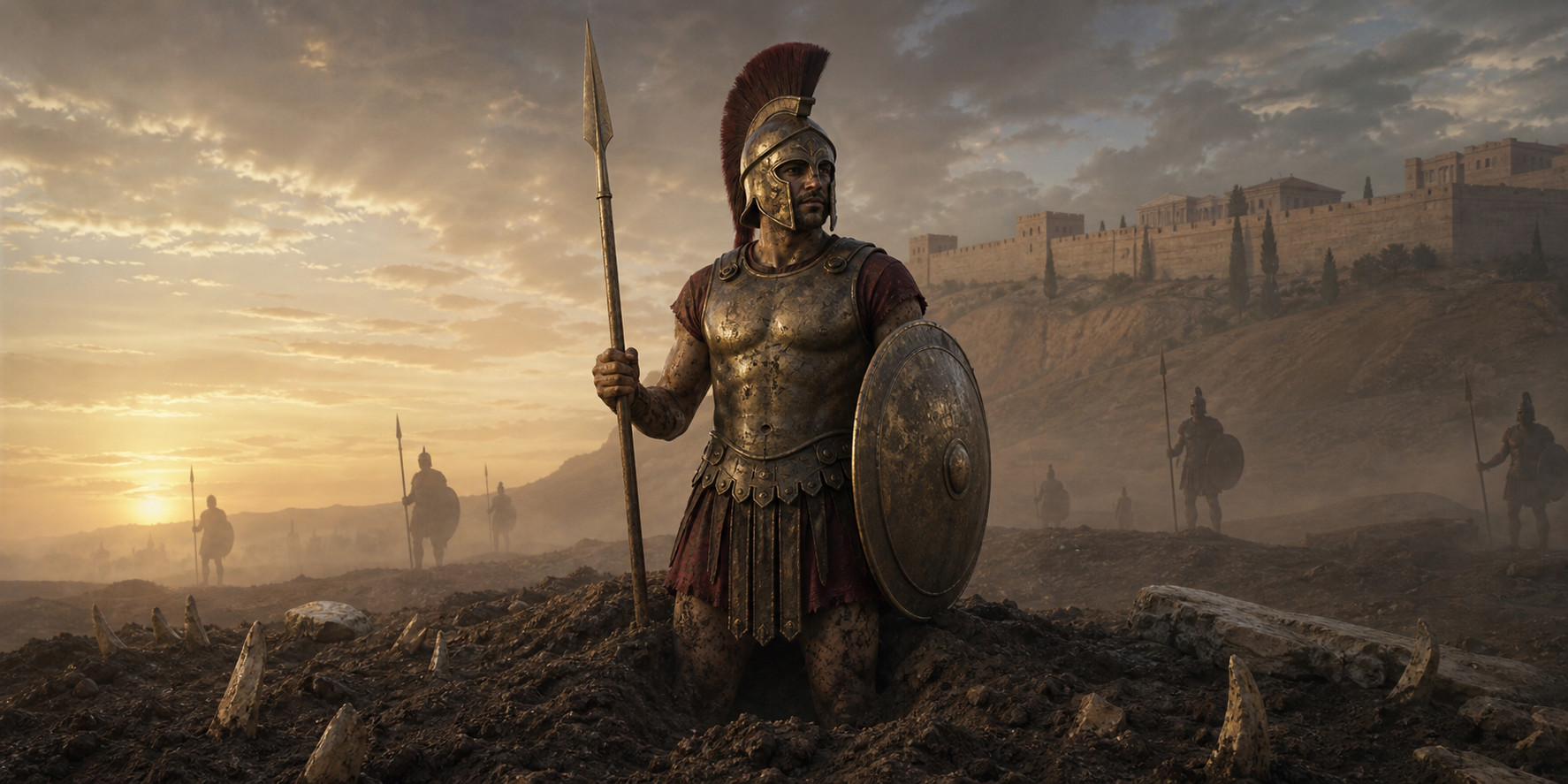
The armed men sown from dragon teeth whose first battle nearly destroys them before five survivors help found Thebes.
- Ares
- Athena
- Cadmus
- Dragon Teeth
- Pentheus
- Thebes
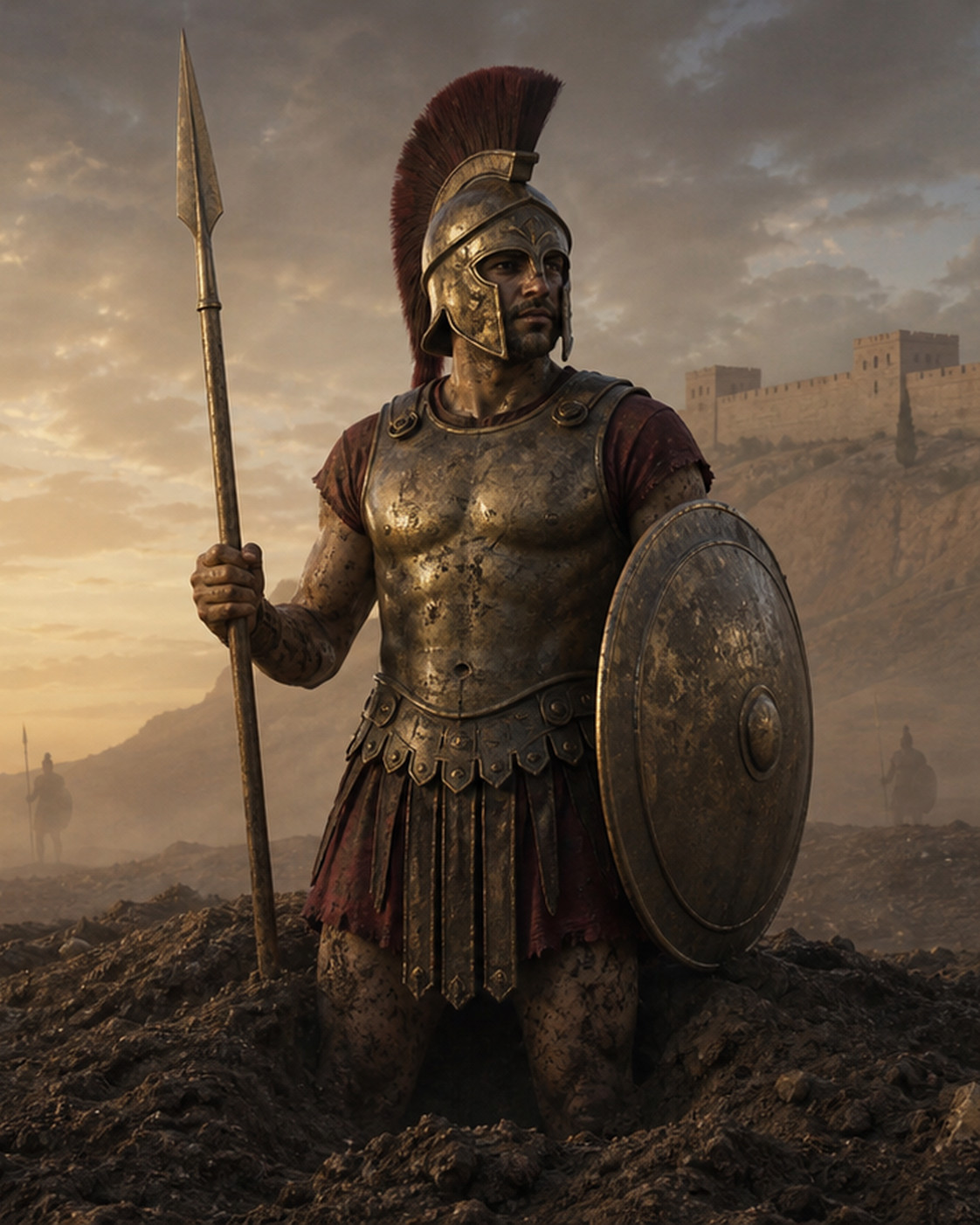
The Spartoi are armed warriors who rise from dragon teeth sown by Cadmus at Athena's command. They fight until five survive, then help found Thebes and become ancestors of its noble houses, including Echion's line through Pentheus.
Greek Mythology Timeline
Move through broad mythic ages and open the events that connect one story to the next. The sequence is a reading path, not an exact historical calendar.
The Spartoi are the earth-born warriors who rise fully armed from dragon teeth sown by Cadmus at the command of Athena. Their name means the Sown Men. Almost immediately they fight one another until only five survive: Echion, Udaeus, Chthonius, Hyperenor, and Pelorus in the familiar list. Those survivors help Cadmus build Thebes and become ancestors of its noble families. The episode gives the city a population born from local soil and sacred violence, while its self-destroying beginning anticipates the civil conflicts that will repeatedly return to the seven-gated city.
The Dragon of Ares
Cadmus follows an oracle and a marked cow to Boeotia. When companions seek water at a spring sacred to Ares, a dragon kills them. Cadmus defeats the creature, but the victory creates a debt to the war god and leaves the founder without the people needed to establish a city.
The dragon is variously described and should not automatically be equated with every serpent in later art. Its stable role is guardianship of the spring and connection with Ares. The city’s first access to water is purchased through killing a sacred defender.
Athena’s Instruction
Athena tells Cadmus to take the dragon’s teeth and sow them in the ground. Other traditions involve division of the teeth between Cadmus and Aeetes, explaining a parallel crop of armed men in the Argonautic story. The seed is martial rather than agricultural.
Sowing ordinarily promises food and continuity. Here the earth produces adults already equipped for combat. The transformation compresses ancestry, growth, training, and armament into a single eruption, making civic manpower appear as both miracle and danger.
Warriors from the Earth
The Spartoi rise from furrows in armor, often imagined with spears and shields emerging before their bodies are fully free. Their autochthony connects them directly to Theban ground rather than to Cadmus’s foreign journey. The city begins through migration joined to native birth.
This double origin matters. Cadmus brings language, search, and kingship from abroad; the Spartoi provide local lineages from the soil. The foundation does not choose between foreign founder and indigenous ancestry. It binds them through a violent ritual.
The Thrown Stone
Cadmus throws a stone among the warriors, and each believes another attacked him. They turn weapons on one another. Some accounts leave the instigator less explicit, but mutual slaughter remains central. A potential army destroys itself before receiving a common task.
The trick resembles later strategies that redirect overwhelming force inward. Yet its consequence is larger than tactical survival. The first political problem of Thebes is mistrust among armed equals, a pattern later repeated when Eteocles and Polynices make inheritance into civil war.
The Five Survivors
Five Spartoi survive in the usual list: Echion, Udaeus, Chthonius, Hyperenor, and Pelorus. Names and details can vary at the edges of tradition. They assist Cadmus and become founders of aristocratic houses remembered as Sparti or descendants of the Sown Men.
Their survival converts uncontrolled violence into civic structure. They are no longer an anonymous crop; each becomes a named ancestor. The city legitimizes later elites through closeness to earth, dragon, Athena’s command, and the founder’s need.
Echion and the Royal House
Echion, whose name evokes the serpent, marries Agave, daughter of Cadmus and Harmonia. Their son Pentheus rules Thebes and opposes Dionysus. Through him the earth-born warrior line enters a family conflict over divine recognition.
The marriage makes Spartoi ancestry part of the royal house rather than a separate military caste. Pentheus’s insistence on civic control can be read against a genealogy born armed from soil and immediate combat, though tragedy does not reduce his personality to ancestry.
Thebes and Autochthony
Greek cities told many stories of origin from their own land. The Spartoi give Thebes a particularly martial version. Autochthony supports belonging and prestige, but the myth also refuses innocence: the ancestors begin by killing one another.
That ambivalence distinguishes them from a simple patriotic emblem. The same local birth that authorizes citizenship carries a memory of internecine violence. Thebes can claim ancient rootedness while its stories repeatedly ask whether kinship prevents or intensifies conflict.
The Question They Open
Follow the Spartoi toward Cadmus for the sowing, Ares for dragon and debt, Athena for instruction, Harmonia for the dynasty they join, Pentheus for Echion’s son, and Thebes for their civic legacy.
The Spartoi ask how a city turns violent capacity into community. Five survive because the first field cannot sustain every armed claimant. Their descendants build institutions and houses, but the earth-born battle remains beneath later sieges as a foundation the city never entirely escapes.
Trivia
- Spartoi means Sown Men.
- Five survivors are named in the familiar list.
- A parallel dragon-tooth sowing appears in the Argonautic cycle.
Reading the Traditions
The Spartoi are a group rather than one character, so visual and narrative treatment must preserve collectivity while keeping the five survivors named. The episode is also not evidence for a historical warrior caste rising literally from soil. It is a foundation myth using agriculture, autochthony, and ambush to explain aristocratic descent and civic violence. Later readers may be tempted to celebrate only the indigenous ancestry or condemn only the mutual killing. The myth keeps both. Thebes receives defenders and noble houses from the earth, but only after suspicion makes the first generation nearly annihilate itself.