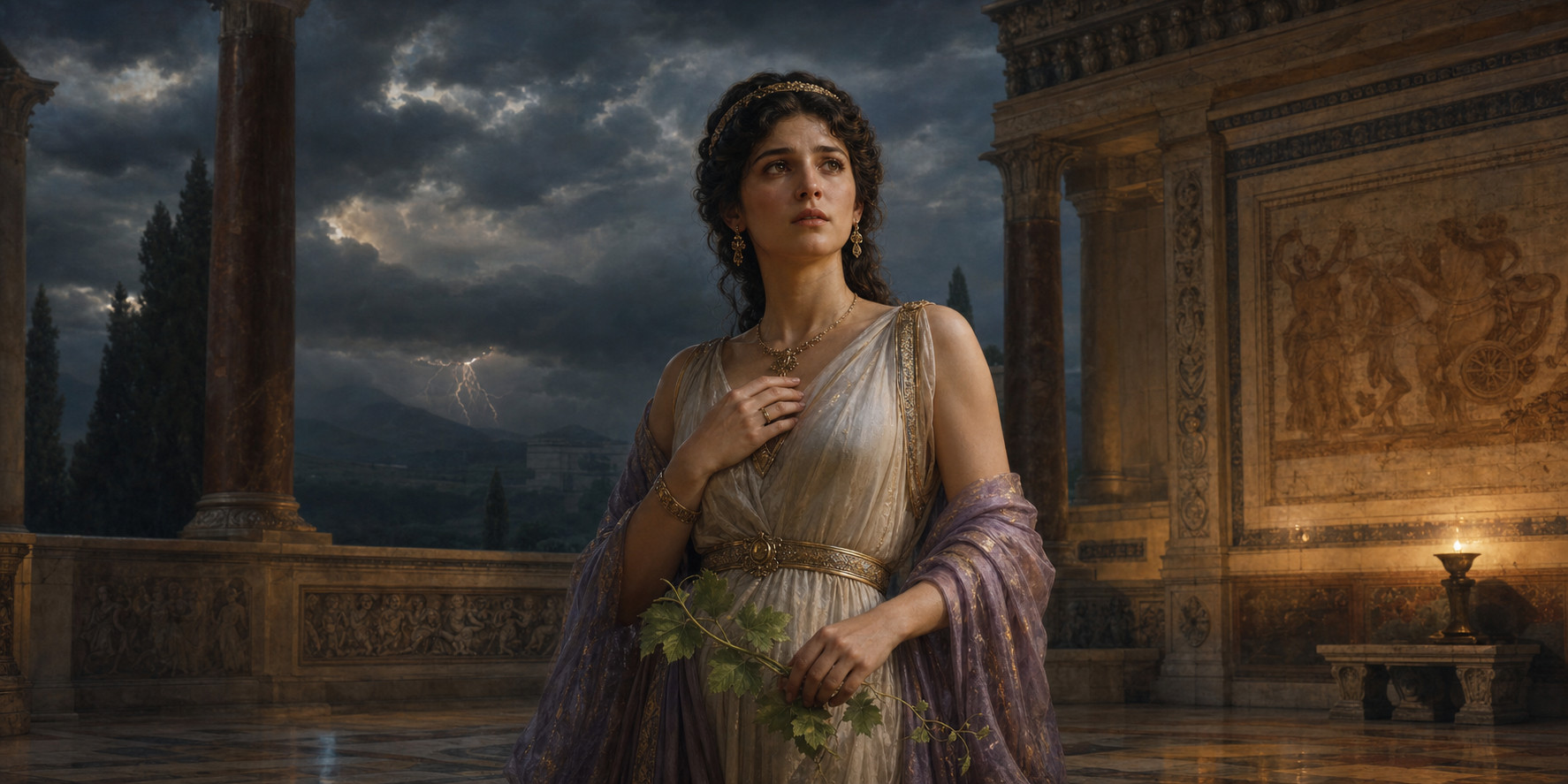
The mortal mother destroyed by revelation, vindicated by her son, and raised as Thyone.
- Cadmus
- Dionysus
- Hera
- Thebes
- Thyone
- Zeus

Semele bears Dionysus by Zeus. Deceived by Hera, she asks Zeus to reveal himself and dies in lightning; Zeus rescues the unborn god, and later Dionysus brings Semele from death as Thyone.
Greek Mythology Timeline
Move through broad mythic ages and open the events that connect one story to the next. The sequence is a reading path, not an exact historical calendar.
Semele is the mortal Theban princess whose union with Zeus produces Dionysus and whose death becomes the proof over which family and city divide. Daughter of Cadmus and Harmonia, she belongs to Thebes’s first royal house. Hera’s deception leads her to request Zeus’s unveiled presence; lightning destroys her body, but Zeus rescues the unborn child and completes the pregnancy in his thigh. Later Dionysus brings her from death as the goddess Thyone.
The Cadmeian House
Hesiod names Semele among the daughters of Cadmus and Harmonia beside Ino, Agave, and Autonoe. Her family joins migration, Ares’s Theban line, Aphrodite’s daughter, and the city founded from the Spartoi. Dionysus is born inside dense divine and civic ancestry.
Semele remains mortal. That boundary gives her story force. Zeus’s attention permits an immortal child, yet a human body cannot safely receive the undisguised storm god. The house gains divine kinship through an encounter it cannot contain.
The Hidden Lover
Zeus visits Semele secretly and she becomes pregnant. Sources do not preserve one courtship biography. Hesiod states union and child compactly, while drama and mythography focus on the public challenge to her claim.
In the Bacchae, her sisters say Semele invented Zeus to hide a mortal lover and that lightning punished the lie. Their denial motivates Dionysus’s return: establishing worship also vindicates his mother’s name.
Hera’s Disguise
A familiar prose tradition has Hera approach Semele disguised as an older woman or nurse. By questioning the lover’s identity she persuades Semele to demand proof. Zeus has sworn to grant a wish and cannot withdraw when she asks to see him as Hera does.
The request is not simple vanity. Semele occupies a relationship of unequal knowledge. She seeks certainty and recognition, but Hera shapes the test around the fatal gap between mortal perception and divine presence. Proof eliminates the witness who asked for it.
Lightning and Rescue
Zeus appears with thunder and lightning, or a limited portion of splendor still unbearable. Semele is consumed and her chamber burns. Dionysus opens the Bacchae beside the tomb and smoking ruins, making death part of Theban sacred geography.
Zeus rescues the unborn child from fire. Semele’s life ends, but maternity cannot be erased. The lightning that destroys her also confirms paternity by preserving Dionysus through a second extraordinary gestation.
The Twice-Born God
Zeus sews the fetus into his thigh until the proper birth. Authors play with its language and location; the stable idea is that Dionysus passes from mortal mother to divine father and is born again.
Double birth explains his passage across mortal and immortal, city and mountain, joy and grief. Even when Zeus completes pregnancy, Dionysus remains the son whose recognition must restore the mother lost at his first birth.
Theban Denial
Agave, Autonoe, and Ino become Bacchants in Euripides. Dionysus drives women from their houses and Pentheus suppresses the rites. The punishment is inseparable from Semele: the god says her sisters’ accusation must be answered.
Pentheus is her nephew through Agave. His refusal repeats family denial as civic policy. When Agave kills her son under delusion, the house learns recognition through another destroyed mother-child bond. Semele’s absent body stands behind the catastrophe.
Return as Thyone
Later myth makes Dionysus descend to the Underworld and bring Semele upward. After apotheosis she is called Thyone and joins the gods. Accounts differ over route and helper, but the transformation reverses the fatal revelation.
The rescue does not restore ordinary mortal life in Thebes; it changes status. Her immortality completes the original claim, not because she could survive Zeus then, but because her son can cross death’s boundary later.
The Question She Opens
Follow Semele toward Dionysus for double birth and descent, Cadmus for her sacred site, Pentheus for denial, Thebes for forced recognition, and Aphrodite through Harmonia’s ancestry. Hera remains the deceiver who makes proof lethal.
Her story asks what mortals can know about divine intimacy and what counts as testimony when a god stays hidden. Motherhood, vindication, cult, and apotheosis ensure that lightning is not her only ending.
Trivia
- Hesiod says Semele and Dionysus both become gods.
- Dionysus defends her honor in the Bacchae.
- Her divine name is Thyone.
Reading the Traditions
Semele rarely controls the surviving narration, so her motives are easily replaced by a moral about curiosity or vanity. The sources support a more careful reading. Her pregnancy is publicly vulnerable, her lover’s identity is concealed by divine necessity, and Hera weaponizes the demand for confirmation. Euripides shifts attention from the fatal request to the family’s refusal to believe her afterward. Mythographers then emphasize rescue of the fetus and later recovery from death. Each version asks a different question: how a mortal can verify divine contact, how testimony survives the speaker, and how a child can restore a mother’s honor. Keeping those questions separate gives Semele a role larger than the moment of lightning. Her story continues through the child she carries, the tomb her father honors, the city that doubts her, and the divine name she receives after recovery. Reading these stages together also prevents Hera’s scheme from becoming Semele’s whole identity: she remains a Theban princess, contested witness, mother, cult figure, and immortal presence.