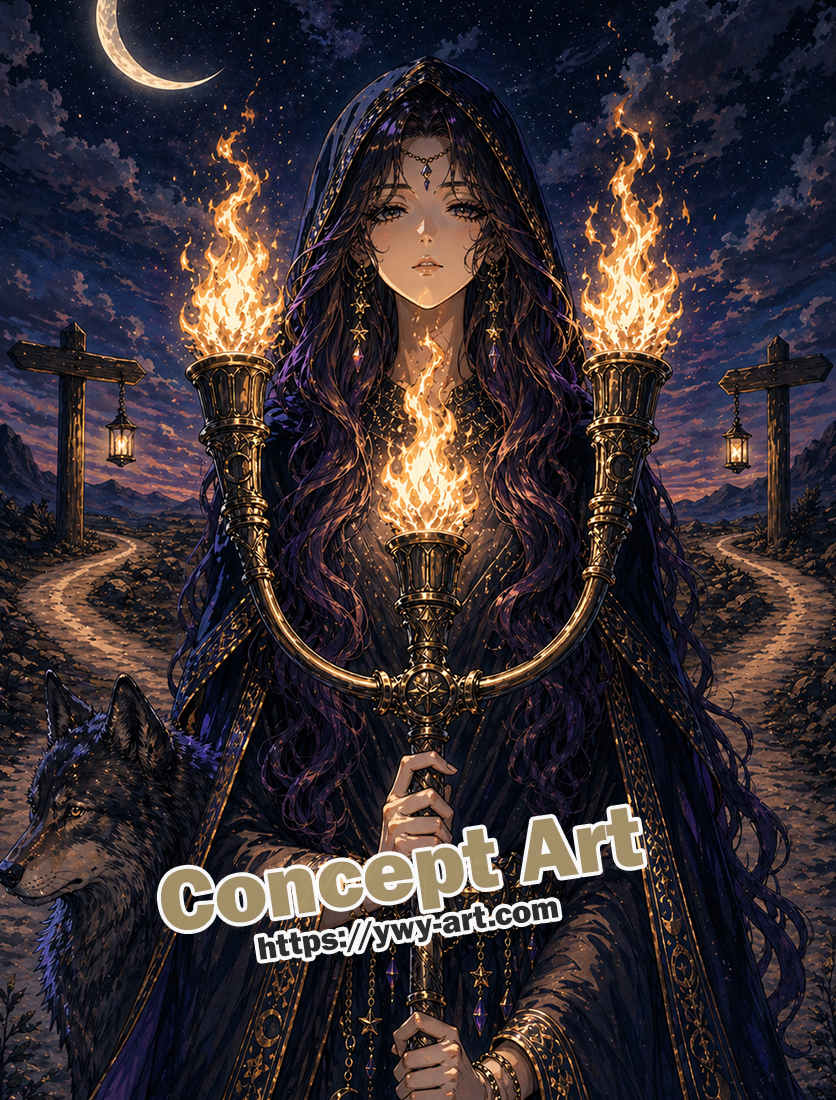
Hecate Triple Torch
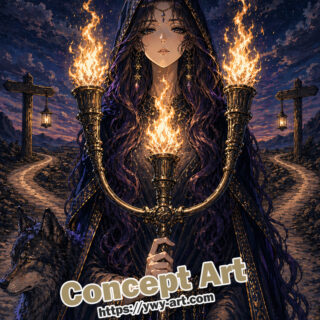
Hecate is not a goddess who belongs fully to one place. She stands at crossroads, in doorways, near graves, under moonlight, and at the edge of what people understand. In this illustration, the Triple Torch becomes the central artifact, burning with three flames beneath a crescent moon and a sky full of stars. It feels mystical, but also very serious. Honestly, this one has that quiet “something is about to be revealed” feeling, and I really like that. Hecate does not need to rush toward the viewer. She waits at the threshold and lets the fire speak first.
Basic Profile
| Name | Hecate |
|---|---|
| Mythology | Greek Mythology |
| Gender | Female |
| Region | Ancient Greece, especially crossroads, thresholds, night roads, and liminal spaces |
| Era | Ancient Greek mythic age and later magical traditions |
| Domain | Magic, crossroads, night, ghosts, thresholds, witchcraft, protection, hidden knowledge |
| Symbol | Torch, key, dagger, dog, serpent, crescent moon, crossroads |
| Culture / Religion | Ancient Greek religion and later esoteric traditions |
| Main Role | Goddess of magic, thresholds, and guidance through darkness |
| Associated Deity | Persephone, Demeter, Artemis, Selene, Hermes, Hades |
| Common Depiction | A torch-bearing goddess, sometimes shown in triple form, standing near crossroads or under the moon |
| Alignment | Mysterious, protective, chthonic, watchful, magical, and deeply connected to hidden paths |
Overview
Hecate is one of the most mysterious figures in Greek mythology. She is often connected with magic, night, ghosts, and crossroads, but she is not simply a dark or frightening goddess. Her power is more subtle than that. Hecate appears where boundaries become uncertain: between life and death, home and wilderness, safety and danger, knowing and not knowing.
That makes her a goddess of transitions. A crossroads is not just a place where roads meet. It is a place where a choice must be made. One path closes behind you, another opens ahead, and for a moment you stand in uncertainty. Hecate belongs to that moment. She does not always give easy answers, but she offers light when the path is unclear.
Her connection to torches is especially important. In the myth of Persephone’s abduction, Hecate hears Persephone’s cry and later helps Demeter in the search for her daughter. The torch becomes a symbol of searching through darkness, not only physically, but emotionally and spiritually. It is the light carried when someone refuses to give up.
In this artwork, the Triple Torch stands directly in front of Hecate, almost like a ritual instrument or sacred gate. The three flames rise around her face and body, while the moon and divided roads behind her reinforce the feeling of choice, mystery, and night travel. The image does not feel loud. It feels watchful. That suits Hecate very well.
The Artifact: Triple Torch
The Triple Torch is a creative artifact built from Hecate’s traditional torch symbolism and her strong association with triple forms. In ancient art and later magical imagery, Hecate is often shown with three bodies or three faces, watching in multiple directions at once. This triple nature connects naturally to crossroads, where more than one path is visible.
A torch is usually a practical object, but in Hecate’s hands it becomes sacred. It lights the road, reveals hidden things, and marks the presence of a goddess who can move through darkness without being lost. The Triple Torch expands that idea. Instead of one flame guiding one path, three flames suggest three directions, three states of being, or three layers of reality.
The number three appears often in symbolic traditions. It can suggest past, present, and future. It can also suggest birth, life, and death, or earth, underworld, and heaven. For Hecate, the triple form feels especially natural because she is not limited to one realm. She watches the crossing points between them.
The artifact in this image has a strong ritual shape. It is not a simple handheld torch. It rises like a ceremonial staff, holding three fires in balance. The flames are bright and warm against the cold night, making the torch feel like both protection and warning. It guides, but it also tells us we are entering sacred territory.
Mythological Background
One of Hecate’s most important appearances is in the story of Demeter and Persephone. When Persephone is taken to the underworld, Hecate hears her cry. Later, she meets Demeter with torches and helps guide the search. This role makes Hecate a witness to loss, but also a companion in the darkness. She does not prevent the descent, but she does not abandon those who suffer through it.
After Persephone becomes queen of the underworld for part of the year, Hecate is often described as her attendant or companion. That detail gives Hecate a deep connection to the underworld without making her simply a goddess of death. She moves near the dead, but she also guides. She stands beside the boundary rather than being trapped on one side of it.
Hecate was also honored at doorways and crossroads. Offerings were sometimes left for her at places where roads met, especially at night. These offerings could ask for protection, favor, or safe passage. This practical religious role matters because it shows Hecate as more than a literary figure. She was a presence people recognized in dangerous or uncertain spaces.
Over time, Hecate became strongly associated with witchcraft, spells, lunar magic, and ghostly power. Later traditions gave her an even darker and more esoteric atmosphere. But even then, the core idea remained consistent: Hecate is the goddess who understands hidden forces and stands where ordinary rules become unstable.
Symbolism and Meaning
The Triple Torch represents guidance through uncertainty. It does not erase darkness. It makes darkness navigable. That is an important difference. Hecate is not a goddess of simple comfort. Her light does not turn night into day. It lets you take the next step without pretending the danger is gone.
The three flames can be read as three possible paths. They may also represent Hecate’s ability to see in multiple directions at once. At a crossroads, humans often feel limited by the path directly in front of them. Hecate sees the side roads, the hidden road, and the road that leads downward.
The crescent moon behind the scene strengthens the sense of liminal power. A crescent is not full light and not full darkness. It belongs to transition. It grows or fades. That makes it an excellent symbol for Hecate, who often appears in moments of change, fear, magic, and decision.
The wolf or dog-like companion in the image also fits her mythology. Dogs are often associated with Hecate, especially as guardians, night creatures, and signs of her presence. A dog may bark at something humans cannot see. That makes it a perfect animal for a goddess connected with ghosts and thresholds.
The two roads behind her are especially strong visually. They do not just decorate the background. They explain the goddess. Hecate stands where the choice happens. The torch is the artifact that lets the traveler face that choice without being completely blind.
Coloring Notes
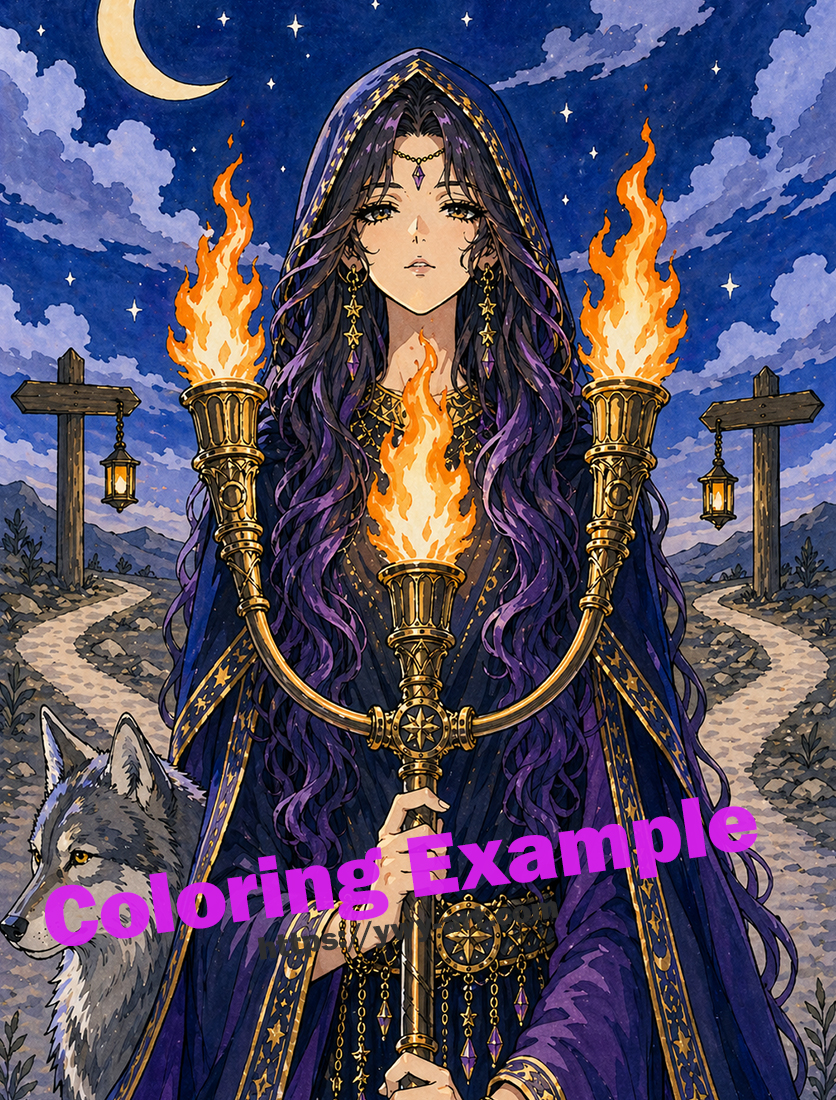
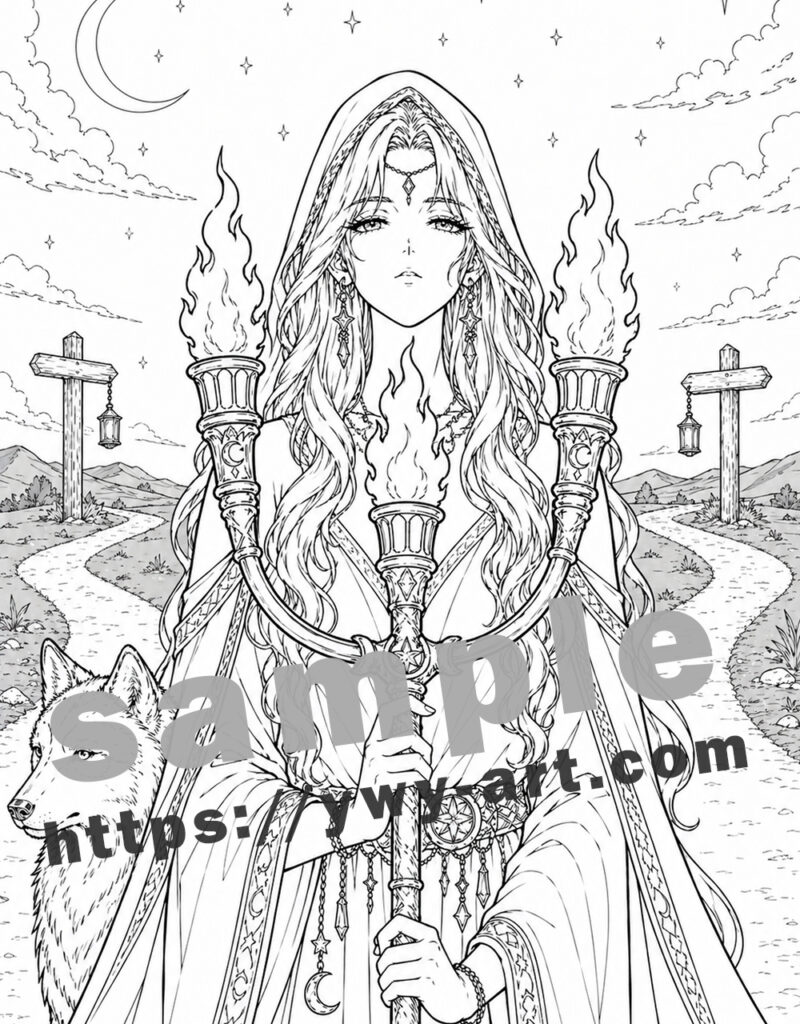
This page works beautifully with a dark night palette and strong flame contrast. Deep navy, black, violet, charcoal, bronze, gold, and warm orange can create a strong magical atmosphere. The torches should probably be the brightest part of the page, because the entire composition depends on fire cutting through darkness.
For the flames, use layered warm tones: pale yellow at the center, orange around it, and deeper red-orange at the outer edges. Leaving small white highlights near the brightest parts can make the fire feel more alive. The three flames should be related, but they do not need to be identical.
Hecate’s robe can use dark blue, black, violet, or deep purple. Gold line details and small star accents will stand out beautifully against the darker cloth. If the robe becomes completely black, some of the design may disappear, so adding blue or purple undertones will help keep the details visible.
The torch metal works well in antique bronze or aged gold. Darker shadows on the lower parts of the staff will make it feel heavy, while brighter highlights near the flames will show the reflected firelight. The crescent moon can stay pale cream or soft gold so it supports the torch without competing with it.
The background roads should stay quieter than the figure. Muted brown, gray, and dark blue can keep them readable without pulling focus away from Hecate and the Triple Torch. The sky can hold small white or pale yellow stars, but too many bright points may reduce the impact of the central fire.
Quick Creative Reference
| Element | Creative Direction |
|---|---|
| Best For | Witchcraft themes, crossroads mythology, night scenes, underworld guidance, magical protection |
| Visual Keywords | Hecate, triple torch, crossroads, crescent moon, flames, night, wolf, hidden path |
| Mood | Mysterious, sacred, dark, protective, watchful, quietly intense |
| Recommended Colors | Deep navy, black, violet, bronze, gold, orange, pale moon yellow, charcoal |
| Main Focus | The Triple Torch as a symbol of guidance, magic, crossroads, and light within darkness |
| Coloring Tip | Keep the brightest contrast around the three flames and use reflected warm light on Hecate’s hands and face. |
Compare with Similar Deities
| Name | Mythology | Main Domains | Overall Image |
|---|---|---|---|
| Hecate | Greek | Magic, crossroads, ghosts, night, thresholds, protection | A mysterious torch-bearing goddess who guides travelers through darkness and hidden paths |
| Artemis | Greek | Hunting, wilderness, moon, protection, young women | A moonlit huntress of wild spaces, more focused on independence, animals, and sacred boundaries |
| Selene | Greek | Moon, night sky, lunar cycles | A radiant personification of the moon, calmer and more celestial than Hecate’s crossroads power |
| Persephone | Greek | Spring, underworld, rebirth, seasonal descent | A queen of the underworld whose story connects life, death, return, and transformation |
Closing
Hecate Triple Torch is a strong artifact piece because it turns light into a choice. The three flames do not simply brighten the scene; they mark the crossroads, the hidden road, and the courage needed to move forward at night. Hecate’s power is not loud, and it is not easy. It is the kind of power that waits in silence until someone reaches the edge of certainty. Then the torch is raised, and the path appears.
Step into the world of mythology..
Available on Amazon Mythology Artifacts Series: Symbols of Power Coloring Book Open in a new tab


コメント