Rhea Mother Stone
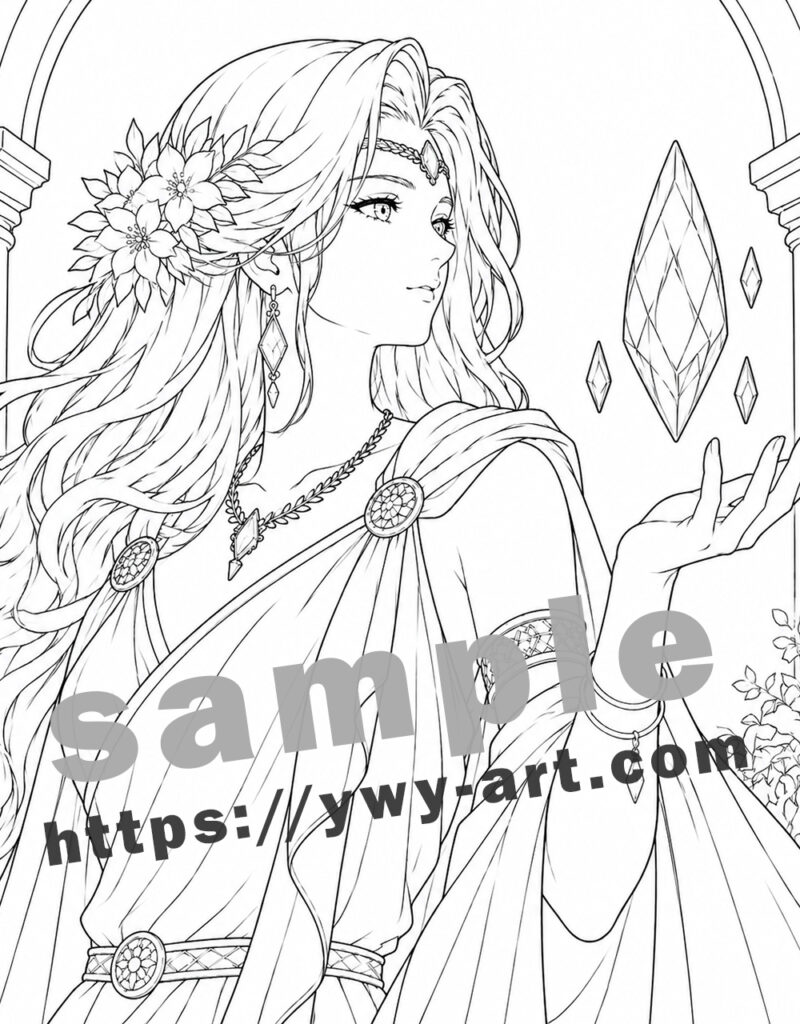
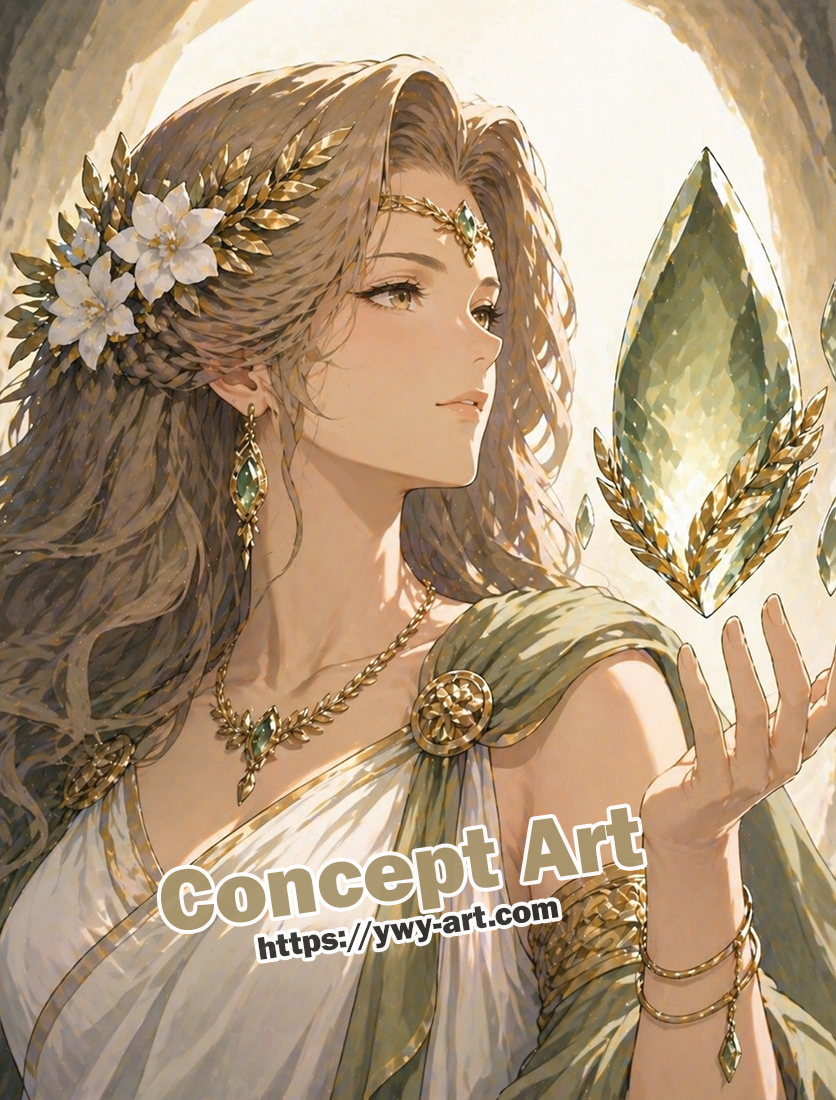
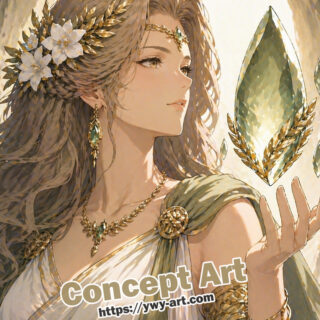
Rhea is often remembered as the mother of the Olympian gods, but her story is not just gentle motherhood. It is also fear, protection, deception, and the quiet courage needed to save the future before it can even speak. In this illustration, the Mother Stone becomes the central artifact, floating beside her like a sacred crystal filled with hidden life. It feels calm and luminous, but honestly, there is something deeply emotional underneath it. Rhea’s power is not loud. It is the power of a mother who knows exactly what must be protected.
Basic Profile
| Name | Rhea |
|---|---|
| Mythology | Greek Mythology |
| Gender | Female |
| Region | Ancient Greek Titan tradition, especially connected with Crete, mountains, and early divine motherhood |
| Era | Age of the Titans, before the full Olympian order |
| Domain | Motherhood, fertility, divine birth, protection, generational transition, mountain sanctuaries |
| Symbol | Stone, lion, drum, mountain, crown, veil, sacred birth imagery |
| Culture / Religion | Ancient Greek myth and Titan-era tradition |
| Main Role | Mother of the Olympian gods and protector of Zeus in infancy |
| Associated Deity | Cronus, Zeus, Hestia, Demeter, Hera, Hades, Poseidon, Gaia, Cybele |
| Common Depiction | A majestic mother goddess, sometimes associated with mountains, lions, drums, or royal maternal imagery |
| Alignment | Maternal, protective, wise, sorrowful, strategic, ancient, and quietly powerful |
Overview
Rhea belongs to the Titan generation, the divine order before the Olympians rose to power. She is the daughter of Uranus and Gaia, and she becomes the consort of Cronus, king of the Titans. Together, they have the children who will later become the great Olympian gods: Hestia, Demeter, Hera, Hades, Poseidon, and Zeus.
But Rhea’s motherhood begins under terrible pressure. Cronus receives a prophecy that one of his children will overthrow him, just as he once overthrew his own father, Uranus. To prevent that future, he swallows each child as soon as they are born. It is one of the most disturbing images in Greek myth: a father trying to consume the next age before it can begin.
Rhea cannot defeat Cronus by force. That is important. Her power works differently. She uses timing, secrecy, and strategy. When Zeus is born, she hides him away and gives Cronus a stone wrapped in baby cloth instead. Cronus swallows the stone, believing it is his son. Because of that deception, Zeus survives.
In this artwork, the Mother Stone becomes more than a simple substitute object. It represents the turning point where a mother’s grief becomes action. The stone stands between destruction and survival. It carries the weight of every child Cronus swallowed, but also the hope that one child might escape and change everything.
The Artifact: Mother Stone
The Mother Stone is a creative artifact based on the famous stone Rhea gives to Cronus in place of Zeus. In the myth, the stone is wrapped like an infant and swallowed by Cronus. Later, when Zeus forces Cronus to release his swallowed children, the stone is also brought back up. In some traditions, it becomes a sacred object connected with Delphi.
This makes the stone a surprisingly powerful symbol. It is not a weapon, not a crown, and not a dazzling tool of battle. Yet it changes the future of the cosmos. Without the stone, Zeus may not survive. Without Zeus, the Olympians may never rise. A simple object becomes the hinge between the Titan age and the Olympian age.
The stone also carries a double meaning. On one side, it is deception. Rhea uses it to fool Cronus. On the other side, it is protection. The deception exists because the child must live. That gives the artifact a very human emotional quality. Sometimes protection is not dramatic. Sometimes it is a quiet substitution made at exactly the right moment.
In this illustration, the stone is imagined as a luminous crystal rather than an ordinary rock. That artistic choice gives it a sacred presence. It feels like a vessel of hidden life, memory, and future kingship. The leaf-like gold forms around it suggest growth and survival, as if the stone itself carries the seed of the next divine order.
Mythological Background
Rhea’s most important myth is inseparable from Cronus and Zeus. Cronus fears the prophecy of succession, so he swallows his children to keep power secure. Rhea suffers through the loss of each child, but when Zeus is born, she decides to act. She hides Zeus in Crete, where he is raised in secret, often with the help of nymphs and the noisy Curetes, who clash their weapons to cover the infant’s cries.
That detail is worth noticing. Zeus does not survive because of strength alone. He survives because many protective forces work together: Rhea’s plan, the hidden cave, the caretakers, the noise that hides him, and the false stone that tricks Cronus. The future ruler of Olympus begins as a vulnerable child who must be protected from his own father.
When Zeus grows up, he eventually forces Cronus to release the swallowed children. The Olympian generation returns, and the great conflict between Titans and Olympians becomes possible. Rhea’s decision therefore does not just save one child. It restores an entire generation.
Rhea is sometimes connected or compared with the Phrygian mother goddess Cybele, especially in later traditions. Both figures are linked with mountains, wild nature, drums, lions, and powerful maternal presence. This connection gives Rhea a broader atmosphere than a single myth scene. She can be seen as an ancient mother force behind divine birth, protection, and the continuation of life.
Symbolism and Meaning
The Mother Stone represents hidden protection. It is a shield disguised as something ordinary. That is what makes it interesting. It does not defeat Cronus by overpowering him. It defeats him because he cannot recognize what is truly valuable. He swallows the stone and misses the child.
The stone also symbolizes the future concealed inside the present. At the moment Cronus takes it, he believes he has prevented prophecy. In reality, the prophecy has already escaped. That gives the artifact a strong mythological irony. The object he accepts as proof of control is actually proof that control has failed.
For Rhea, the stone is tied to grief and strategy. She has already lost children to Cronus’ fear. The stone is not playful trickery. It is desperate intelligence. It is a mother’s answer to tyranny when direct confrontation is impossible.
The crystal-like form in the artwork adds a sense of sacred memory. It can be read as a preserved fragment of the Titan age, but also as the seed of the Olympian world. The soft green-gold tones suggest earth, growth, and continuity. This is not a dead stone. It feels like something waiting to become history.
Coloring Notes
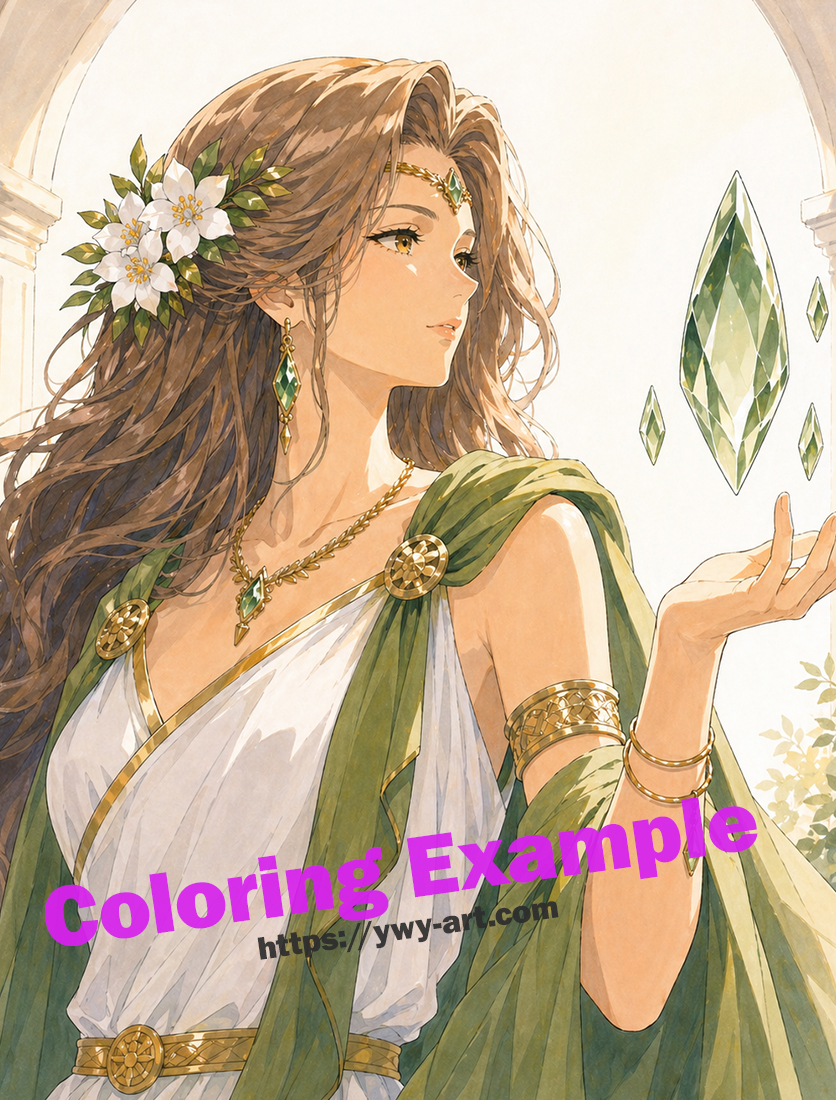
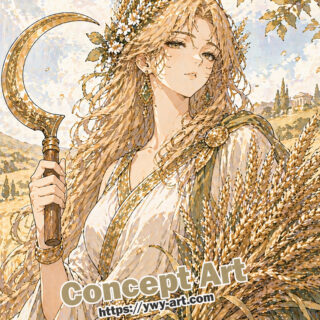
This page works beautifully with soft earth and sunlight colors. Warm cream, pale gold, olive green, honey brown, ivory, and muted sage can create a gentle but ancient atmosphere. The Mother Stone should remain the main artifact focus, so it helps to give the crystal a clearer glow than the surrounding clothing and background.
For the stone, green crystal tones can work very well: pale jade, olive, yellow-green, and soft smoky gray. Adding brighter highlights along the upper edges will make it feel luminous. The gold leaf shapes around it can use antique gold or warm bronze to connect the artifact to divine protection.
Rhea’s clothing can stay soft and natural. White, cream, muted green, and light gold will support the mother-goddess atmosphere without becoming too heavy. If the fabric is shaded with pale olive or warm gray, it will feel grounded and organic.
Her hair can be colored in wheat blonde, honey brown, soft ash gold, or light chestnut. Since the scene has a warm sunlight feeling, leaving some brighter highlights around the hair and flowers will help the image feel calm and sacred.
The background can remain gentle and open. Pale sky blue, soft beige, and light green are enough. This illustration does not need harsh contrast. The emotional power comes from quiet protection, so the coloring can stay restrained while letting the Mother Stone shine slightly brighter than everything else.
Quick Creative Reference
| Element | Creative Direction |
|---|---|
| Best For | Titan mythology, mother goddess themes, divine birth, protection, generational transition |
| Visual Keywords | Rhea, Mother Stone, Zeus, Titan age, crystal, protection, hidden child, sacred motherhood |
| Mood | Gentle, ancient, protective, sorrowful, hopeful, quietly strategic |
| Recommended Colors | Pale gold, ivory, olive green, jade, cream, honey brown, muted sage, warm bronze |
| Main Focus | The stone as a symbol of maternal protection, deception against tyranny, and the survival of the next divine age |
| Coloring Tip | Keep the Mother Stone slightly brighter and more translucent than the surrounding fabric so it feels like the sacred center of the scene. |
Compare with Similar Deities
| Name | Mythology | Main Domains | Overall Image |
|---|---|---|---|
| Rhea | Greek | Motherhood, Titan lineage, divine birth, protection, succession | An ancient mother goddess who protects Zeus and makes the rise of the Olympians possible |
| Gaia | Greek | Earth, primordial motherhood, creation, prophecy | The primordial Earth Mother, older and more cosmic than Rhea, giving birth to the first divine generations |
| Cybele | Phrygian / Anatolian | Mother goddess, mountains, wild nature, lions, ecstatic worship | A powerful Great Mother figure often associated with mountains, drums, lions, and ancient fertility |
| Demeter | Greek | Agriculture, grain, motherhood, seasonal grief and return | A nurturing but sorrowful mother goddess whose grief shapes the fertility of the earth |
Closing
Rhea Mother Stone is a strong artifact piece because it turns a quiet object into the beginning of a cosmic revolution. The stone is not a weapon, but it saves Zeus. It is not alive, yet it protects the future. Rhea’s strength is not shown through battle here. It is shown through timing, sorrow, and the choice to act when everything seems already lost. That makes the Mother Stone gentle on the surface, but incredibly powerful underneath.
Step into the world of mythology..
Available on Amazon Mythology Artifacts Series: Symbols of Power Coloring Book Open in a new tab
コメント