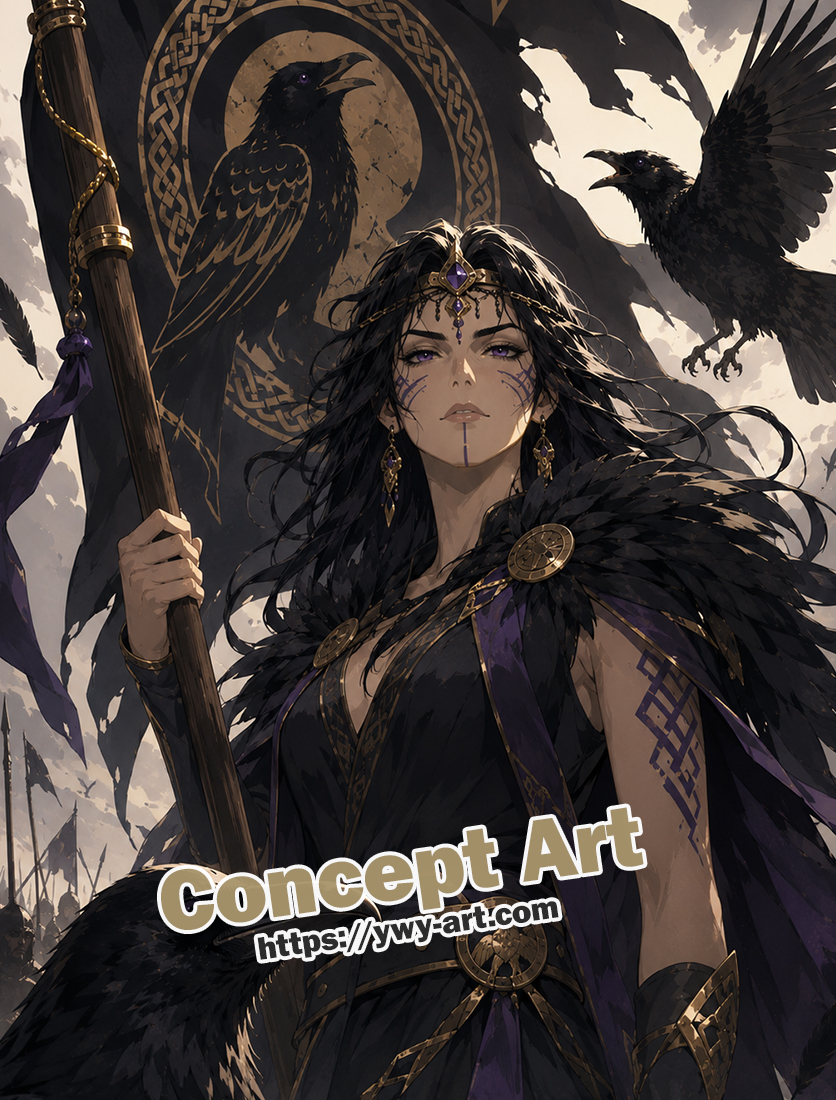
Morrigan Raven War Banner
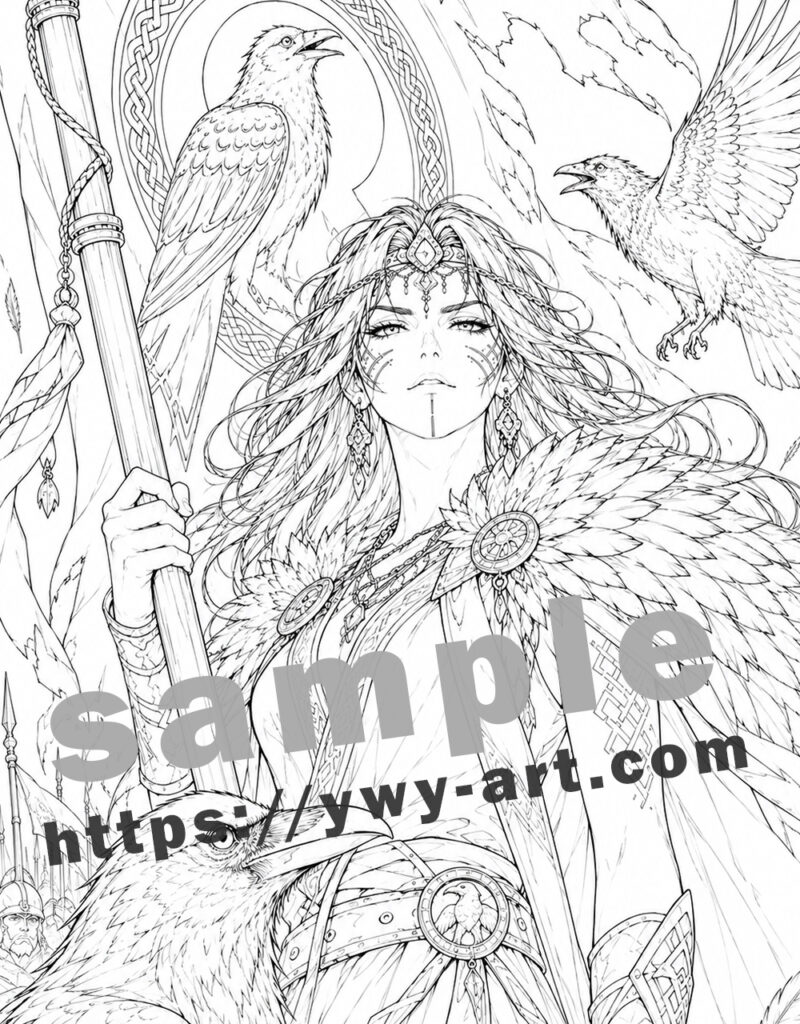
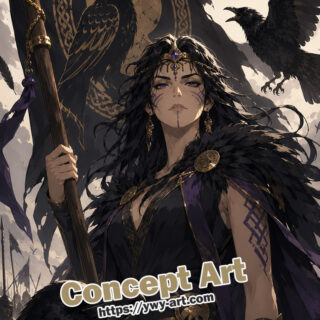
The Morrigan stands in this artwork with the kind of presence that feels like a warning before the battle even begins. Black ravens circle around her, the war banner rises behind her, and the whole scene carries a heavy, storm-like silence. She does not look frantic or wild here. She looks certain. And honestly, that makes her even more intimidating.
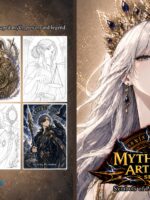
This piece belongs to the Mythology Artifacts Series, a coloring book collection focused on divine weapons, sacred relics, and symbolic objects from world mythology. In this illustration, the central artifact is the Raven War Banner, a symbolic battle standard inspired by the Morrigan’s connection to war, fate, sovereignty, and the raven as an omen of death and victory.
Basic Profile
| Name | The Morrigan |
|---|---|
| Mythology | Irish and Celtic mythology |
| Gender | Female deity |
| Region | Ireland and the wider Celtic world |
| Domain | War, fate, prophecy, sovereignty, battle frenzy, death, and transformation |
| Artifact | Raven War Banner |
| Associated Symbol | Raven, crow, battlefield, prophecy, blood, sovereignty, black feathers |
| Main Role | A war goddess and prophetic figure who appears around battle, death, and royal power |
| Common Depiction | A dark goddess associated with ravens, battlefields, shapeshifting, and ominous prophecy |
| Overall Image | Severe, prophetic, dangerous, regal, and deeply connected to war’s shadow |
Overview
The Morrigan is one of the most powerful and mysterious figures in Irish mythology. She is often described as a goddess of war and fate, but that simple label does not really cover everything she represents. She is not only about fighting. She is about the feeling that surrounds battle: fear, prophecy, blood, victory, loss, and the strange pull of destiny.
In many stories, the Morrigan appears near warriors, kings, and battlefields. Sometimes she takes the form of a raven or crow. Sometimes she appears as a woman who speaks warnings, offers prophecy, or tests the courage of heroes. Her presence often means that something cannot be avoided anymore. The battle has already entered the realm of fate.
That is why this artwork feels so fitting. The Morrigan is not shown swinging a sword or rushing into combat. Instead, she stands like a figure of command, with ravens around her and a dark banner behind her. The scene feels less like the middle of a fight and more like the moment when war has already chosen its direction.
The Artifact: Raven War Banner
The Raven War Banner is the central artifact of this illustration. It is not a single fixed object from one famous myth in the same way as a named sword or spear, but it is built from the Morrigan’s strongest symbolic world. A war banner is not just decoration. It gathers identity, loyalty, fear, and purpose into one visible sign.
For the Morrigan, a raven-marked banner feels especially natural. Ravens and crows are strongly connected to battlefields, death, prophecy, and the aftermath of war. They appear where bodies fall, but they also watch from above, as if they already know the ending before humans do.
In this image, the banner works like a declaration. It does not need bright colors or heroic shine. Its dark cloth, raven emblem, and ritual-like presence make it feel like a sacred object of war. It is the kind of banner that would not comfort an army. It would remind them that fate is already walking beside them.
Mythological Background
The Morrigan is often linked with a group or triad of warlike goddesses, and her identity can be complex. In different sources, she is associated with names such as Badb, Macha, and Nemain. These figures are connected to battle, panic, prophecy, sovereignty, and the terrifying energy that surrounds war.
One of the most famous mythic connections is with the hero Cú Chulainn. The Morrigan encounters him, challenges him, and later appears around the events leading toward his death. Her role is not always simple. She can oppose, test, warn, or reveal. That uncertainty is part of what makes her so compelling.
She is also closely tied to sovereignty. In Celtic myth, the land, rulership, and the right to power are often connected through divine female figures. The Morrigan’s relationship with kingship and battle suggests that war is not only physical violence. It is also political, spiritual, and tied to the fate of the land itself.
The raven form is especially important. A raven can be a scavenger, a messenger, an omen, and a watcher. It is not only a symbol of death. It is also a symbol of knowing. In this artwork, the ravens do not feel like background animals. They feel like extensions of the goddess herself.
Symbolism and Meaning
The strongest theme in this artwork is fate before battle. The Morrigan’s expression is calm, but the ravens, torn flags, dark feathers, and battlefield atmosphere suggest that violence is close. The tension is already there. It does not need to be shouted.
The banner represents collective destiny. A warrior may carry a weapon for themselves, but a banner belongs to a larger force. It marks a side, a cause, a death sentence, or a prophecy. In the Morrigan’s hands, or even in her presence, the banner becomes more than a military sign. It becomes an omen.
The ravens add movement and warning. One raven watches from below. Another flies with its beak open, almost like it is crying out over the battlefield. The large raven emblem behind the Morrigan gives the scene a ritual quality, as if her war banner has become a sacred symbol burned into the air.
The color mood also matters. Black, gray, purple, muted gold, and pale skin tones create a world that feels cold and dangerous. There is beauty here, but it is not gentle beauty. It is the beauty of storm clouds, dark feathers, and a battlefield that has gone quiet for one breath too long.
Coloring Notes
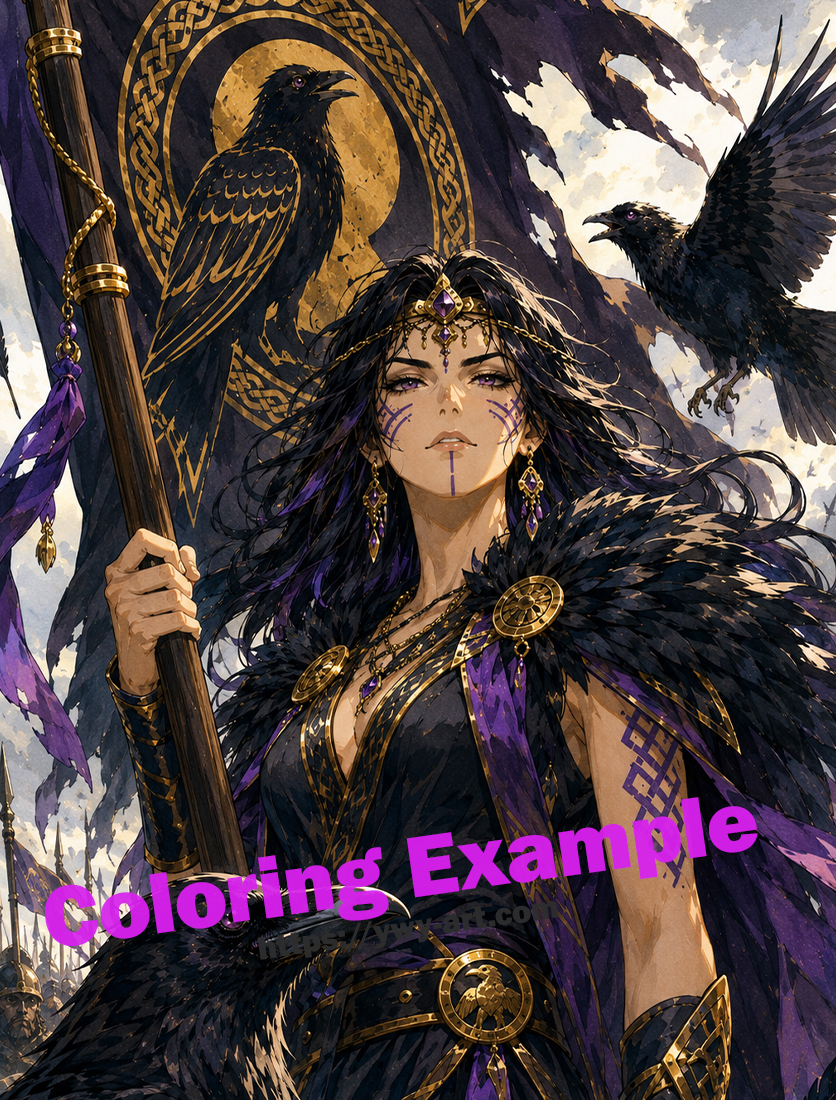
This page works best with a controlled dark palette. Black is obviously important, but it should not become flat. Try building the ravens and cloak with layers of dark gray, charcoal, blue-black, violet-black, and small pale highlights. That will keep the feathers readable and give the image more depth.
Purple is a strong accent color for the Morrigan. It can suggest prophecy, mystery, and royal authority without making the image too bright. Deep violet, muted plum, and dark purple shadows can work well on cloth, ribbons, eye details, or magical markings.
Gold should be used carefully. The jewelry, belt details, banner ornaments, and staff accents can use antique gold or bronze. Too much bright gold may weaken the dark warlike mood, so smaller metallic highlights will probably work better.
For the banner, dark gray, black, weathered brown, or faded charcoal can create an old battlefield feeling. The raven emblem can be slightly lighter or slightly warmer than the cloth, so it remains visible without becoming too decorative.
The background can stay muted with gray skies, pale smoke, dusty beige, and soft shadow tones. This will help the Morrigan’s face, ravens, and dark clothing remain the main focus. If you want more drama, a faint purple glow around the eyes or markings could add a supernatural touch without overwhelming the page.
Quick Creative Reference
| Element | Creative Direction |
|---|---|
| Ravens | Use charcoal, blue-black, violet-black, and pale edge highlights to keep the feathers readable. |
| War Banner | Dark gray, black, weathered brown, or faded charcoal can create an old battlefield mood. |
| Purple Accents | Deep violet and muted plum work well for prophecy, mystery, and royal severity. |
| Gold Details | Use antique gold or bronze sparingly on ornaments, belt parts, and staff accents. |
| Skin and Face | Keep the skin pale or softly warm so the face stays visible against the dark costume. |
| Overall Mood | Ominous, prophetic, regal, battle-worn, and quietly terrifying. |
Compare with Similar Deities
| Name | Mythology | Main Domains | Overall Image |
|---|---|---|---|
| The Morrigan | Irish and Celtic mythology | War, fate, prophecy, sovereignty, death | A raven-linked war goddess who appears around battle, omens, and the fate of heroes. |
| Freyja | Norse mythology | Love, war, magic, beauty, chosen dead | A powerful goddess connected to desire, battle, sorcery, and the honored dead. |
| Athena | Greek mythology | War strategy, wisdom, protection, crafts | A disciplined war goddess who represents intelligence, order, and tactical victory. |
| Kali | Hindu mythology | Time, death, destruction, fierce protection | A fierce goddess who destroys evil, ego, and illusion with overwhelming divine force. |
Coloring Variations
- Raven Queen Version: Use black, charcoal, deep violet, pale skin, and antique gold for a regal dark-goddess look.
- Battlefield Omen Version: Add gray skies, dusty beige smoke, weathered banners, and muted bronze accents.
- Prophecy Glow Version: Keep the palette dark, but add small purple highlights around the eyes, markings, or raven symbols.
- Ancient Celtic Version: Use weathered green, dark brown, bronze, black feathers, and knotwork-inspired accents.
Closing
Morrigan Raven War Banner is a coloring page about war before the blade falls. The banner, ravens, and dark ceremonial clothing all point toward a goddess who does not simply fight. She watches, predicts, tests, and claims the atmosphere of battle itself.
For colorists, this piece offers a strong chance to work with dark feathers, muted metallics, purple accents, pale skin tones, and battlefield shadows. The key is not to make everything equally black. Let the dark areas breathe with small shifts in gray, violet, and blue-black, so the ravens and cloak stay alive.
In the end, this artwork shows the Morrigan as a presence of fate. The Raven War Banner is not just a flag. It is a sign that the battlefield has already been marked, and somewhere above it, the ravens know what is coming.
Step into the world of mythology..
Available on Amazon Mythology Artifacts Series: Symbols of Power Coloring Book Open in a new tab

コメント