Dionysus Ivy Chalice
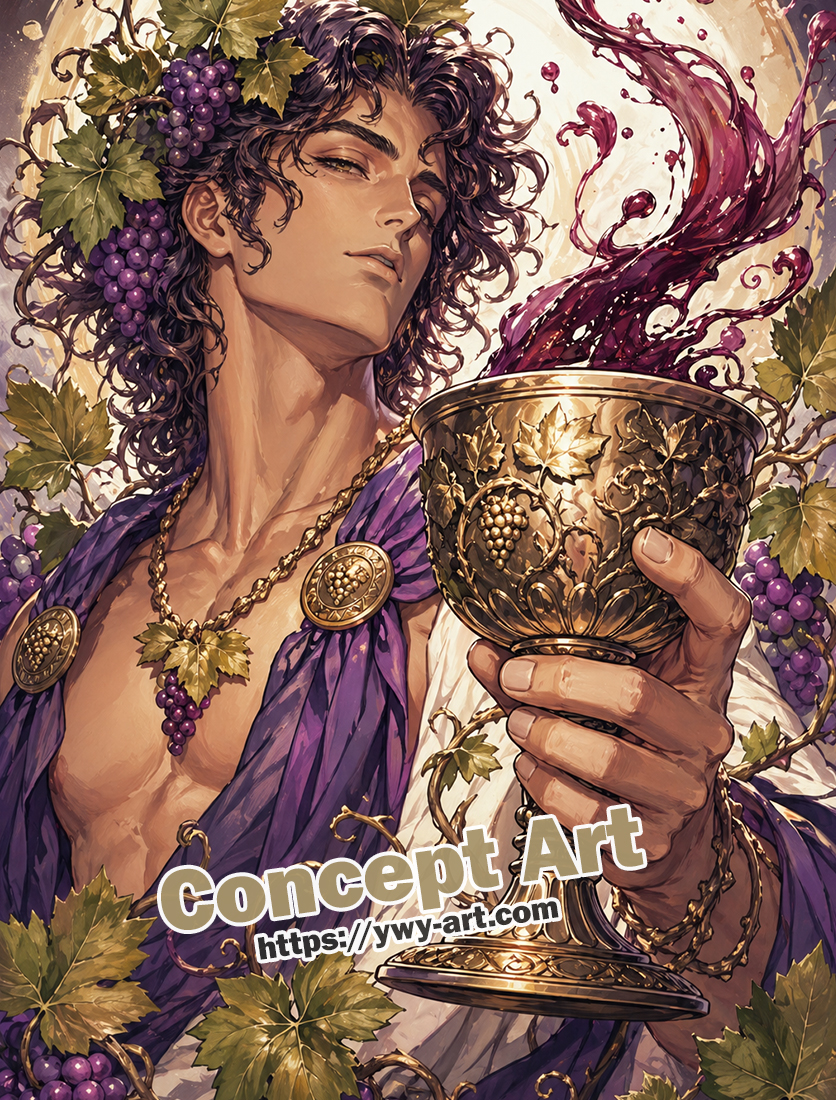
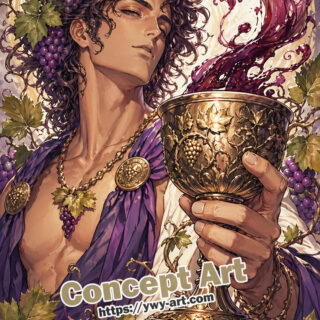
Dionysus is easy to misunderstand if we only think of him as a cheerful god of wine. Yes, he is connected with grapes, feasts, music, theater, and intoxication. But beneath that celebration, there is something much stranger and more powerful. Dionysus is the god who loosens control. He brings joy, but also madness. He opens the body, the voice, the crowd, and sometimes the parts of the soul people try to keep hidden. In this illustration, the Ivy Chalice becomes the center of that wild sacred energy, overflowing with deep red wine and surrounded by twisting vines. Honestly, this one feels seductive in a dangerous way, and that is exactly right for Dionysus.
Basic Profile
| Name | Dionysus |
|---|---|
| Mythology | Greek Mythology |
| Gender | Male |
| Region | Ancient Greece, especially vineyards, mountains, theaters, and ecstatic ritual spaces |
| Era | Ancient Greek mythic age |
| Domain | Wine, ecstasy, theater, fertility, madness, revelry, transformation, liberation |
| Symbol | Grapes, ivy, chalice, thyrsus, leopard, mask, vine, wine |
| Culture / Religion | Ancient Greek religion |
| Main Role | God of wine, ecstatic ritual, theater, and the breaking of ordinary boundaries |
| Associated Deity | Zeus, Semele, Ariadne, Silenus, Maenads, Satyrs, Apollo |
| Common Depiction | A youthful or bearded god crowned with ivy or grapevines, often holding wine or a thyrsus |
| Alignment | Joyful, wild, seductive, dangerous, liberating, ecstatic, and unpredictable |
Overview
Dionysus is one of the most unusual Olympian gods. He belongs to celebration, but also to loss of control. He is connected with wine, but wine in Greek myth is never just a drink. It is transformation in liquid form. It warms the body, loosens speech, changes behavior, dissolves social masks, and can turn a quiet gathering into something loud, emotional, and unpredictable.
His birth story already marks him as a god of strange thresholds. Dionysus is the son of Zeus and the mortal woman Semele. When Semele asks to see Zeus in his true divine form, she cannot survive the sight. Zeus saves the unborn Dionysus by sewing him into his thigh until he is ready to be born. Because of this, Dionysus carries a double quality from the beginning: mortal and divine, dead and reborn, hidden and revealed.
That sense of crossing boundaries follows him everywhere. Dionysus moves between civilization and wilderness, joy and terror, human and animal, self-control and ecstatic release. His followers, especially the Maenads, are often shown entering states of divine frenzy. In that state, ordinary identity breaks open. People become something larger, freer, and sometimes frightening.
In this artwork, the Ivy Chalice captures Dionysus through one strong image. The cup is beautiful and ceremonial, but the wine rising from it feels alive. The grape leaves, purple cloth, golden metal, and twisting red liquid all suggest pleasure, abundance, and danger at the same time. This is not a calm cup of wine at dinner. It feels like a ritual has already started.
The Artifact: Ivy Chalice
The Ivy Chalice is a creative artifact built from Dionysus’ most important symbols: wine, grapevines, ivy, ritual drinking, and ecstatic transformation. A chalice naturally suggests offering, communion, and sacred drinking. In the world of Dionysus, it becomes more than a vessel. It is a threshold. Once the wine is taken in, the boundary between ordinary self and divine frenzy begins to soften.
Ivy is especially important for Dionysus. Like grapevines, ivy climbs, wraps, spreads, and refuses to stay neatly contained. It grows over walls and around trees, blurring edges. Symbolically, that fits Dionysus perfectly. He is the god who covers the hard lines of social order with something living, green, and impossible to fully control.
The chalice in this illustration is decorated with grape and leaf motifs, making it feel like an object used in a sacred feast or mystery ritual. The overflowing wine does not behave like ordinary liquid. It rises and curls in the air, almost like smoke, blood, or living spirit. That visual choice is powerful because Dionysian wine is not passive. It acts on the world.
The gold of the cup gives the artifact a royal and divine quality, while the deep red-purple wine brings the image back to the body: blood, desire, heat, and intoxication. The Ivy Chalice is beautiful, but it also asks a dangerous question. What happens when control is no longer the highest value?
Mythological Background
Dionysus appears in Greek myth as both a bringer of joy and a punisher of those who deny his divinity. One of the clearest examples is the story of Pentheus in Euripides’ play The Bacchae. Pentheus refuses to honor Dionysus and tries to control the god’s worship. Dionysus responds not by fighting him in a simple battle, but by unraveling his perception, his authority, and finally his life. It is a disturbing story, and it shows how dangerous it is to treat Dionysus as harmless.
The Maenads, female followers of Dionysus, are central to his mythology. They enter ecstatic states in the mountains, dancing, shouting, and becoming possessed by divine frenzy. In some stories, this worship is joyous and liberating. In others, it becomes violent and terrifying. That contrast is not a mistake. Dionysus contains both sides. Ecstasy can heal the soul, but it can also tear apart the person who loses all grounding.
Dionysus is also deeply connected to theater. Greek tragedy and comedy developed in religious contexts linked to Dionysian festivals. That makes him more than a god of wine. He is also a god of masks, performance, voice, and emotional release. Theater lets people become someone else for a while. It lets grief, laughter, fear, and desire appear in public form. That is very Dionysian.
His relationship with Ariadne also adds a softer layer. After Theseus abandons Ariadne on Naxos, Dionysus finds her and makes her his bride. In some traditions, he raises her to divine status. This story shows Dionysus not only as a god of frenzy, but also as a god who can transform abandonment into elevation. Again, his power is change.
Symbolism and Meaning
The Ivy Chalice represents sacred intoxication. That does not only mean drunkenness. It means the moment when the ordinary self becomes loosened and something deeper comes forward. In a safe ritual, that can feel like freedom, creativity, music, dance, and emotional release. Without balance, it can become chaos.
The grapevines and ivy show abundance, but also entanglement. They are beautiful plants, yet they wrap around everything they touch. This makes them perfect symbols for Dionysus. His influence is not straight or clean. It curls, spreads, seduces, and pulls people into motion.
The chalice itself can be read as a container for controlled madness. A cup gives shape to liquid. A ritual gives shape to ecstasy. Dionysus is dangerous when there is no container at all, but he is also powerful because he reminds people that too much control can become its own prison.
The red wine rising from the cup also suggests life force. It looks close to blood, but not exactly. It feels like pleasure, danger, memory, and body heat all blending together. That is why the image has such strong presence. It is not just showing a beautiful object. It is showing temptation in motion.
Coloring Notes
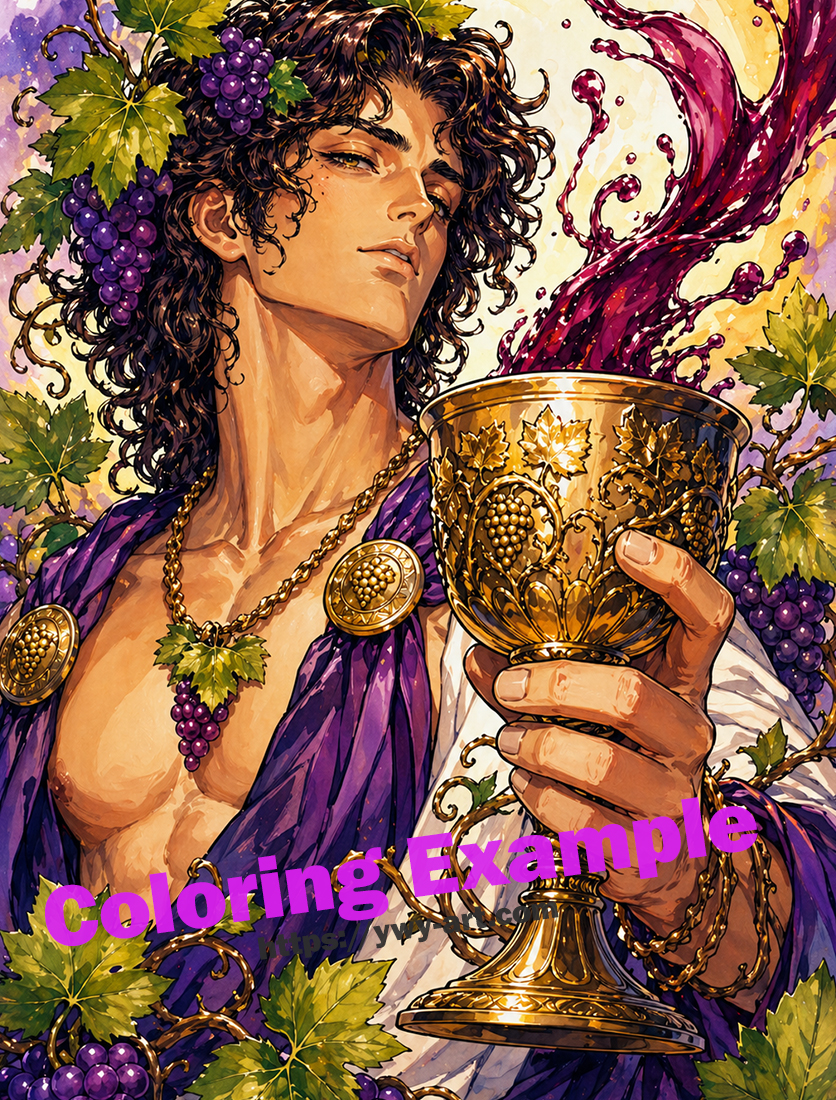
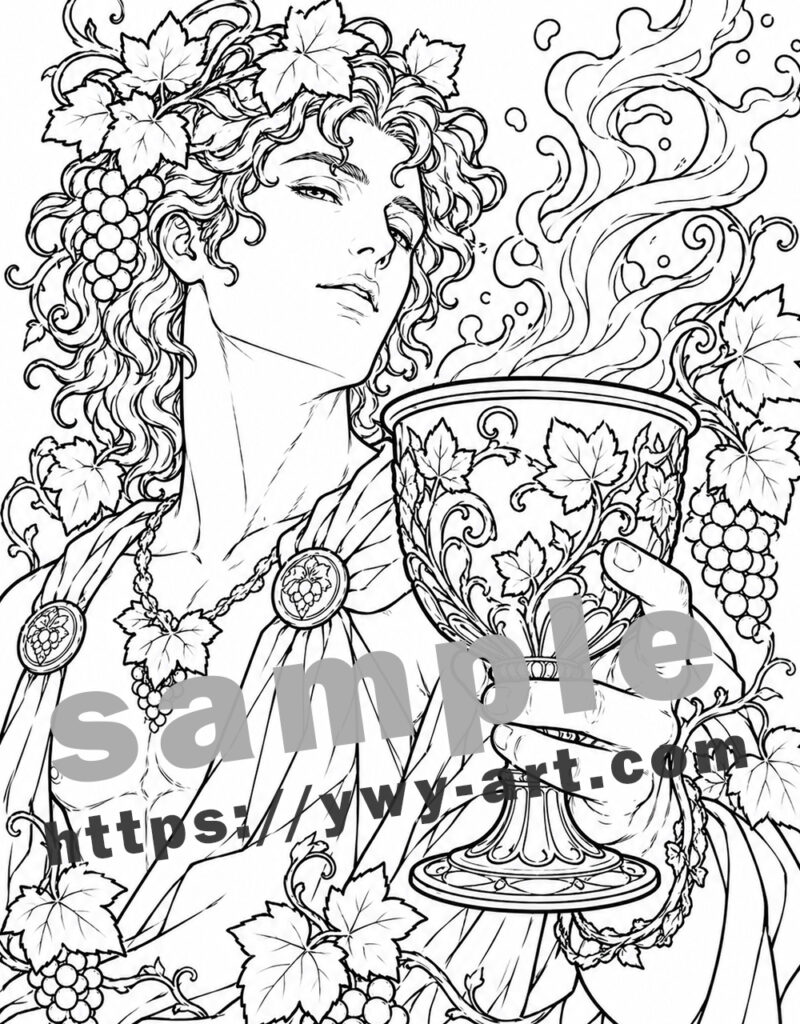
This page works beautifully with rich vineyard colors. Deep purple, wine red, olive green, antique gold, warm brown, and cream can create a strong Dionysian atmosphere. The chalice should stay the visual center, so the gold metal and red wine need clear contrast against the surrounding vines and clothing.
For the wine, try using several related tones instead of one flat red. Dark burgundy, crimson, purple-red, and small bright highlights can make the liquid feel alive. The most intense color can be placed near the top of the splash and around the cup’s opening, where the movement begins.
The grape leaves can use olive green, yellow-green, and muted brown shadows. If every leaf is colored the same way, the frame may become flat, so small variations help a lot. The grapes can be colored in dark purple, violet, or even blue-purple to separate them from the red wine.
The chalice itself works well in antique gold or bronze. Adding darker shadows under the rim and inside the carved leaf details will make the cup feel heavy and ornate. The raised grape motifs can receive brighter highlights so they do not disappear into the metal.
Dionysus’ clothing can be colored in purple, wine red, or deep violet. Gold jewelry and grape ornaments will connect him visually to the chalice. His skin can stay warm and slightly sunlit, which helps balance the darker wine tones and keeps the image from becoming too heavy.
Quick Creative Reference
| Element | Creative Direction |
|---|---|
| Best For | Wine mythology, ecstatic ritual, vineyard themes, divine temptation, theatrical atmosphere |
| Visual Keywords | Dionysus, ivy chalice, wine, grapes, vines, ecstasy, ritual cup |
| Mood | Seductive, rich, wild, festive, dangerous, intoxicating |
| Recommended Colors | Deep purple, wine red, burgundy, olive green, antique gold, warm brown, cream |
| Main Focus | The chalice as a vessel of wine, ecstasy, transformation, and divine release |
| Coloring Tip | Use the strongest red-purple tones in the wine and keep the chalice highlights bright so the artifact remains the center of the page. |
Compare with Similar Deities
| Name | Mythology | Main Domains | Overall Image |
|---|---|---|---|
| Dionysus | Greek | Wine, ecstasy, theater, fertility, madness, transformation | A wild and seductive god who dissolves control through wine, ritual, and ecstatic freedom |
| Bacchus | Roman | Wine, revelry, intoxication, liberation | The Roman counterpart of Dionysus, strongly associated with feasting, wine, and ecstatic celebration |
| Pan | Greek | Wild nature, music, shepherds, instinct, panic | A rustic god of untamed nature and instinctive energy, less ceremonial but deeply wild |
| Osiris | Egyptian | Death, rebirth, vegetation, kingship, afterlife | A god of renewal and resurrection, connected to fertility and cycles of life in a more solemn way |
Closing
Dionysus Ivy Chalice is a strong artifact piece because it makes wine feel mythological again. The chalice is not just a cup, and the wine is not just a drink. It is release, danger, pleasure, and transformation rising in one red-purple swirl. Dionysus reminds us that joy can be sacred, but it is never completely safe. That tension is what gives this image its power.
Step into the world of mythology..
Available on Amazon Mythology Artifacts Series: Symbols of Power Coloring Book Open in a new tab





















コメント