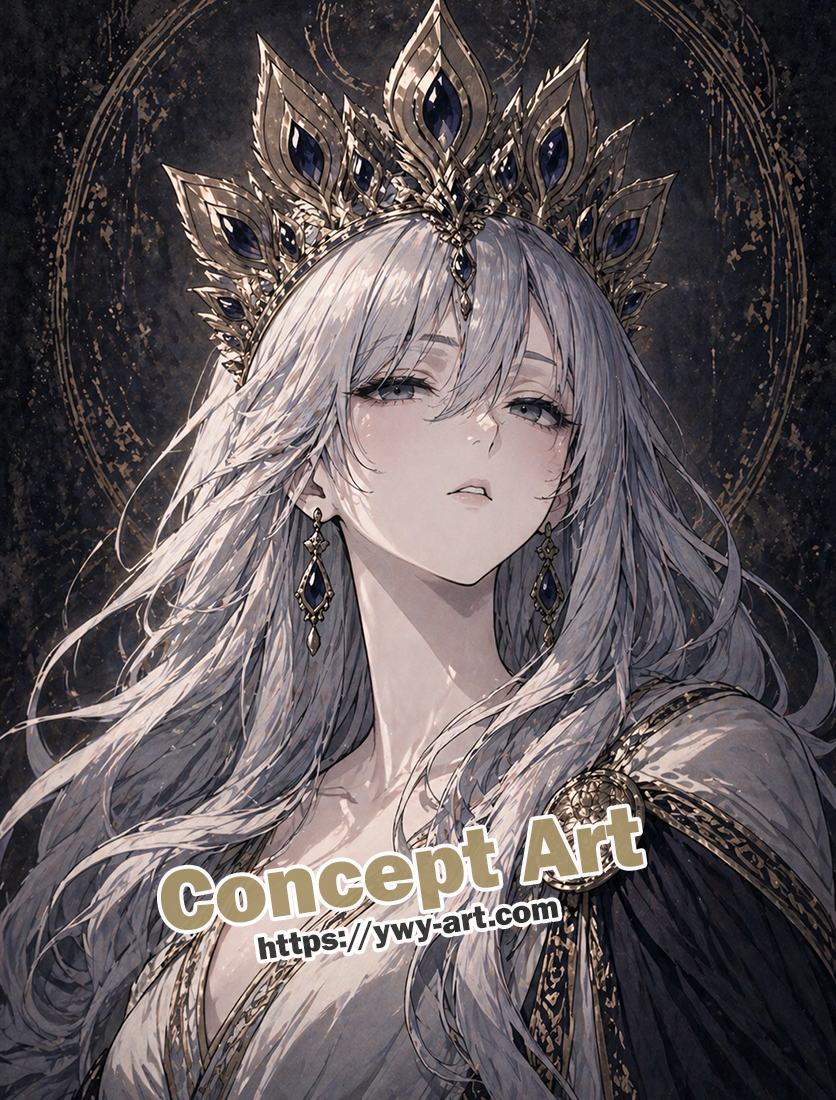
Hera Peacock Crown
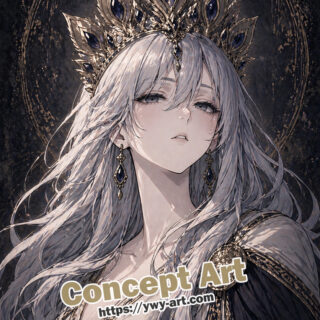
Hera is often remembered through stories of jealousy and punishment, but that is only the surface. She is the queen of Olympus, the goddess of marriage, royal authority, legitimacy, and the difficult weight of divine order. In this illustration, the Peacock Crown becomes the central artifact, rising above her silver-white hair like a cold and elegant halo. It is beautiful, but not soft. Honestly, this piece has a quiet pressure that I really like. Hera does not need to move much. The crown already tells us who is in command.
Basic Profile
| Name | Hera |
|---|---|
| Mythology | Greek Mythology |
| Gender | Female |
| Region | Ancient Greece, especially Argos, Samos, and major sanctuaries connected to marriage and queenship |
| Era | Ancient Greek mythic age |
| Domain | Marriage, queenship, women, family order, legitimacy, royal authority |
| Symbol | Peacock, crown, diadem, scepter, cow, pomegranate, veil |
| Culture / Religion | Ancient Greek religion |
| Main Role | Queen of Olympus and goddess of marriage and lawful union |
| Associated Deity | Zeus, Hebe, Ares, Hephaestus, Eileithyia, Argus Panoptes, Io |
| Common Depiction | A regal goddess wearing a crown or veil, often shown with a peacock, scepter, or royal ornaments |
| Alignment | Regal, proud, protective, severe, dignified, and difficult to challenge |
Overview
Hera is one of the most powerful goddesses in Greek mythology. As the wife of Zeus and queen of the Olympian gods, she stands at the center of divine hierarchy. But her role is not only personal. She represents the structure of marriage, family, royal legitimacy, and social order. In other words, Hera is not just “Zeus’ wife.” She is the goddess who gives divine weight to lawful bonds and recognized authority.
That makes her a complicated figure. Many myths show her anger toward Zeus’ lovers and children born outside their marriage. Those stories can make her seem harsh, and sometimes she absolutely is. But when we look at the larger symbolic picture, her anger comes from a place of violated order. Hera is the queen, and every betrayal is not only emotional. It is political, sacred, and cosmic.
This is why her crown matters so much. A crown is not just jewelry. It marks rank. It tells everyone where power sits. The Peacock Crown in this artwork feels like a visual declaration of Hera’s identity: beauty, authority, pride, surveillance, and divine dignity all gathered into one artifact.
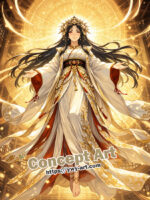
The image presents Hera in a calm, almost untouchable way. Her expression is not warm, but it is not wild either. She looks distant, controlled, and aware of her position. That works very well for Hera. She is not a goddess of sudden chaos. Her power feels older, colder, and more institutional. She is the throne room, not the battlefield.
The Artifact: Peacock Crown
The Peacock Crown is a creative artifact built from Hera’s strongest symbols: queenship, divine marriage, peacock imagery, jewels, and royal authority. The peacock is one of Hera’s most famous sacred animals, often connected to the story of Argus Panoptes, the many-eyed guardian.
In myth, Hera uses Argus to guard Io, one of Zeus’ lovers. After Hermes kills Argus, Hera places his eyes on the peacock’s tail, turning the bird into a lasting symbol of watchfulness and royal splendor. This gives the peacock a much deeper meaning than simple beauty. It represents vision, vigilance, memory, and the queen’s ability to see what others try to hide.
The crown in this illustration uses feather-like shapes and dark blue jewel accents that suggest peacock eyes. That design choice is important. It does not feel like a generic royal crown. It feels specifically Hera’s. Each pointed form resembles a feather, but also a blade or a watching eye. The result is elegant, but slightly intimidating.
A crown also turns Hera’s power into something visible. Zeus may rule with thunder, Poseidon with the sea, and Hades with the underworld. Hera rules through status, law, marriage, and recognition. Her crown is not a weapon in the usual sense, but it can still dominate a scene. It says: this is the queen, and her gaze has consequences.
Mythological Background
Hera’s mythology is filled with conflict, especially around Zeus’ repeated betrayals. Stories involving Io, Europa, Leto, Semele, Heracles, and others often show Hera responding with punishment or pursuit. These myths are uncomfortable at times, but they reveal how seriously ancient myth treated the disruption of marriage and lineage.
Her treatment of Heracles is especially famous. Heracles is the son of Zeus and the mortal woman Alcmene, and Hera becomes one of the greatest sources of suffering in his life. She sends madness, obstacles, and danger against him. Yet even here, the story becomes more complex. Heracles eventually achieves divine status and, in some traditions, is reconciled with Hera. The conflict does not simply vanish, but it becomes part of a larger mythic transformation.
Hera is also associated with childbirth and women’s life stages, sometimes through her daughter Eileithyia, goddess of childbirth. This connects Hera not only to marriage as a social institution, but to the continuation of family lines and legitimate descent. Again, her role is bigger than emotion. She protects the framework through which households, kingdoms, and divine ancestry are understood.
Important cult centers such as Argos and Samos worshiped Hera as a major goddess in her own right. This matters because literary myths can sometimes make her appear mainly as a reactive figure beside Zeus. Religious worship gives us a broader view. Hera was honored as a powerful queenly goddess, a protector of marriage, and a divine presence worthy of temples, festivals, and deep respect.
Symbolism and Meaning
The Peacock Crown represents sovereign dignity. It is beauty with hierarchy behind it. The crown does not ask for attention in a soft way. It demands recognition. That fits Hera perfectly because her power is tied to position, legitimacy, and the right to be acknowledged.
The peacock symbolism adds the idea of watchfulness. The “eyes” of the peacock tail suggest that nothing escapes Hera’s notice. This can feel protective or frightening depending on the story. For those under her protection, Hera’s gaze may mean order and dignity. For those who betray her, it becomes judgment.
The dark blue gems in the crown can be read as night-like eyes or royal stones. Blue adds coldness, distance, and depth. It keeps the crown from feeling purely decorative. The metal structure feels sharp and ceremonial, as if it belongs to a goddess who has carried authority for a very long time.
Hera’s pale appearance in this composition also strengthens the crown’s meaning. Her face is calm, almost still, and the crown becomes the most assertive part of the image. That contrast is effective. She does not need exaggerated movement because the artifact carries her identity upward, like a silent proclamation.
Coloring Notes
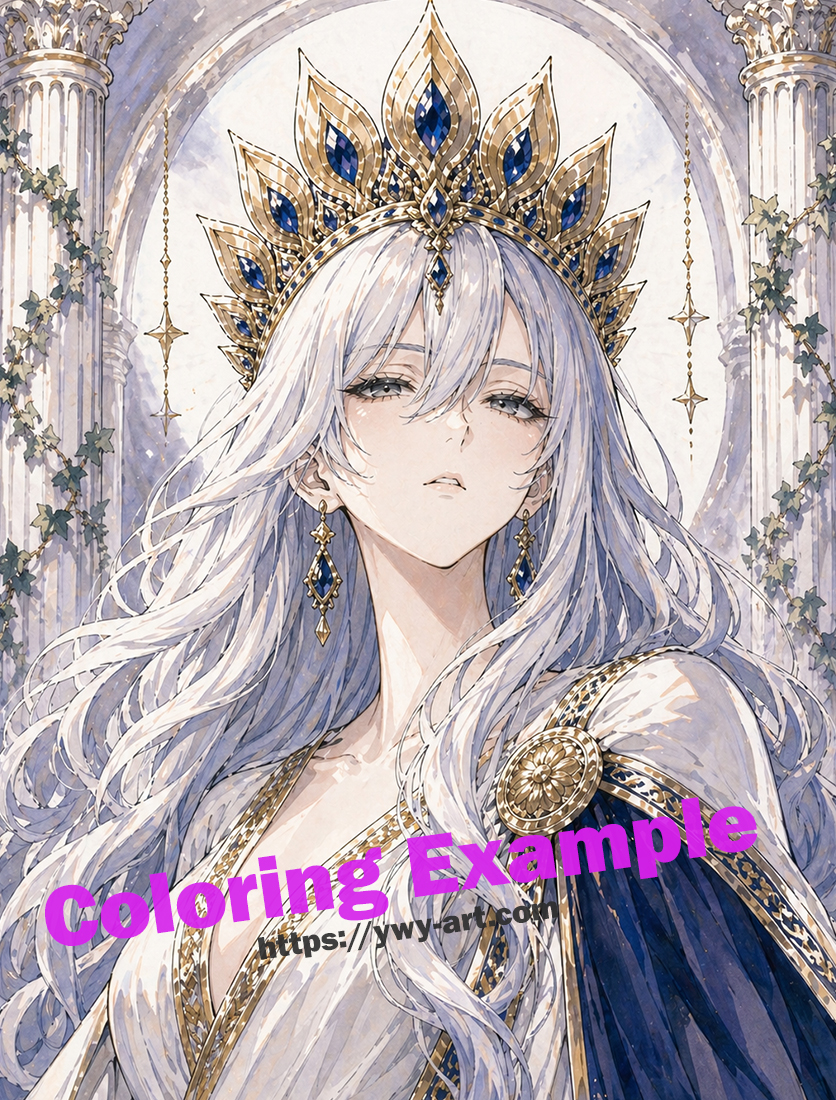
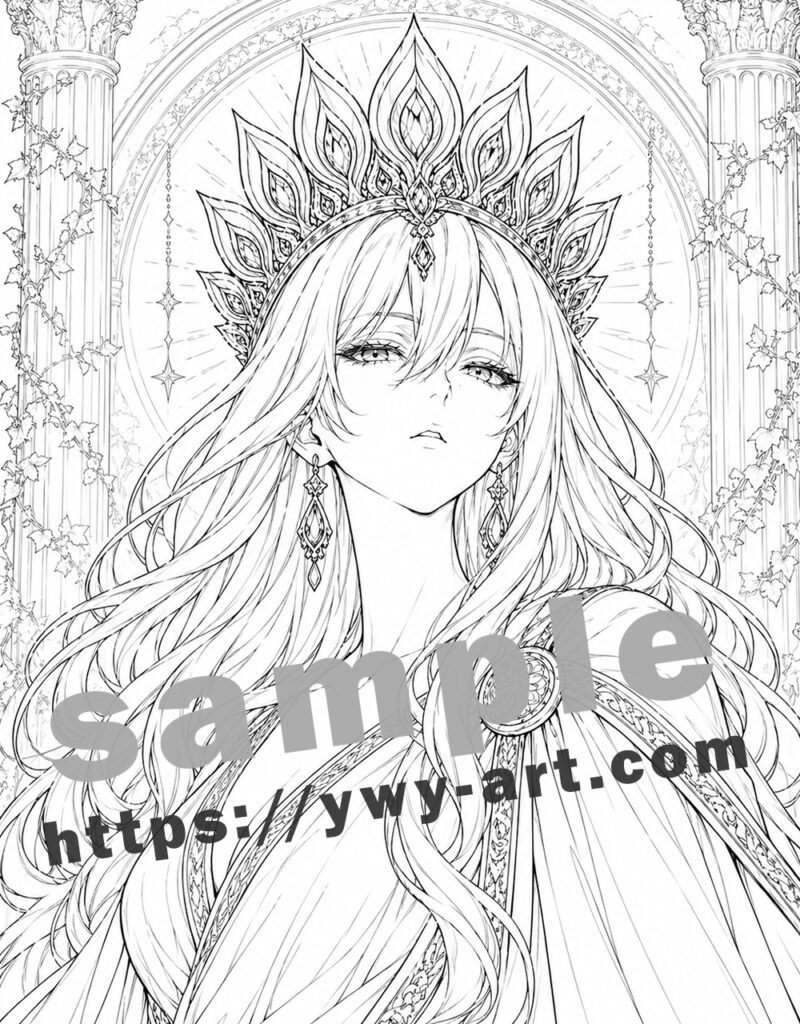
This page works beautifully with a refined royal palette. Silver, ivory, dark blue, muted gold, charcoal, pearl gray, and soft violet can create a dignified Hera atmosphere. The crown should remain the main focus, so the jewel tones need enough depth to stand out from the pale hair.
For the Peacock Crown, antique silver or pale gold can both work. Silver gives Hera a colder and more distant presence. Gold makes her feel more traditionally royal. The feather-shaped elements can be shaded carefully so they do not flatten into one shape. Keeping the tips slightly brighter will help the crown feel sharp and elevated.
The peacock-like jewels are a good place for strong color. Deep sapphire, blue-black, indigo, or dark teal can give the crown weight. Small white highlights inside the stones will make them feel like watchful eyes without needing to overdo the effect.
Hera’s hair can stay silver-white, pale ash, or very light blue-gray. If the hair becomes too dark, the crown may lose contrast. Her skin can be soft and cool-toned, with restrained shadows. This is not a warm festival scene. It should feel quiet, regal, and slightly severe.
The background can use charcoal, smoky gray, muted bronze, or dark navy. The circular halo-like ornament behind her head should stay subtle, not brighter than the crown. If the background becomes too busy, Hera’s calm expression may lose impact. Let the crown and face carry the scene.
Quick Creative Reference
| Element | Creative Direction |
|---|---|
| Best For | Queenly mythology, divine authority, marriage symbolism, elegant dark fantasy portraits |
| Visual Keywords | Hera, peacock crown, queen of Olympus, jewels, royal gaze, divine marriage |
| Mood | Regal, cold, elegant, proud, watchful, severe |
| Recommended Colors | Silver, ivory, sapphire blue, dark teal, muted gold, charcoal, pearl gray |
| Main Focus | The crown as a symbol of Hera’s queenship, vigilance, and divine legitimacy |
| Coloring Tip | Use deeper blues in the crown jewels and keep Hera’s hair lighter so the Peacock Crown stays visually dominant. |
Compare with Similar Deities
| Name | Mythology | Main Domains | Overall Image |
|---|---|---|---|
| Hera | Greek | Marriage, queenship, women, legitimacy, royal authority | A severe and majestic queen of the gods whose beauty carries law, rank, and judgment |
| Juno | Roman | Marriage, women, childbirth, state protection, queenship | The Roman counterpart of Hera, often more strongly linked to civic protection and Roman identity |
| Frigg | Norse | Marriage, motherhood, fate, household authority | A queenly goddess with a quieter, more domestic and fate-connected form of power |
| Isis | Egyptian | Queenship, magic, motherhood, protection, resurrection | A powerful divine queen and magician, more nurturing and restorative than Hera but equally sovereign |
Closing
Hera Peacock Crown is a strong artifact piece because it captures power without needing action. The crown does the work: peacock eyes, sharp metal, dark jewels, and royal height all point to Hera’s place as queen of Olympus. She is beautiful here, yes, but the beauty is not gentle decoration. It is authority made visible. Hera’s crown reminds us that divine power can be cold, watchful, and absolutely unwilling to be ignored.
Step into the world of mythology..
Available on Amazon Mythology Artifacts Series: Symbols of Power Coloring Book Open in a new tab



コメント