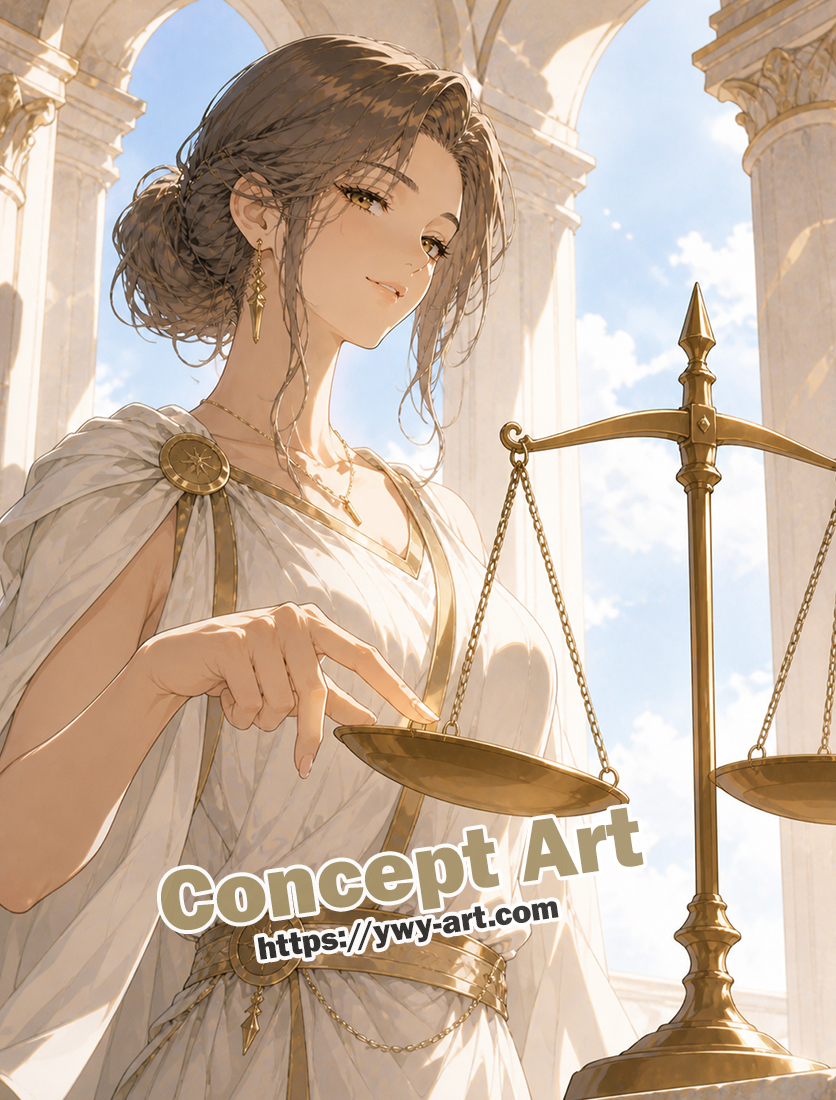
Themis Judgment Scales
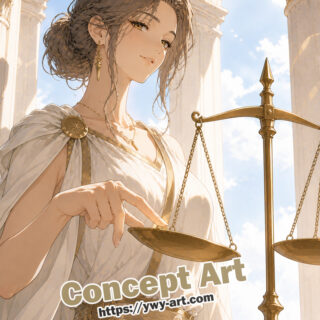
Themis is not simply a goddess holding a pair of scales. She represents something much older and heavier than ordinary law: divine order, sacred custom, prophecy, fairness, and the balance that allows the world to make sense. In this illustration, the Judgment Scales become the central artifact, shining like a sacred instrument between truth and consequence. It feels calm, but not gentle in a soft way. Honestly, this one has a quiet seriousness that I really like. Themis does not look like she is arguing for justice. She looks like justice has already arrived.
Basic Profile
| Name | Themis |
|---|---|
| Mythology | Greek Mythology |
| Gender | Female |
| Region | Ancient Greece, especially divine councils, sacred law, and prophetic traditions |
| Era | Titan generation and early divine order before the full Olympian system |
| Domain | Divine law, justice, order, fairness, prophecy, sacred custom, rightful balance |
| Symbol | Scales, sword, blindfold, tablet, throne, oracle, balanced light |
| Culture / Religion | Ancient Greek myth and religious tradition |
| Main Role | Titaness of divine order and sacred law |
| Associated Deity | Zeus, Gaia, the Horae, the Moirai, Dike, Nemesis, Apollo |
| Common Depiction | A solemn goddess holding scales, sometimes connected with prophecy, law, or divine judgment |
| Alignment | Wise, impartial, ancient, lawful, prophetic, balanced, and difficult to deceive |
Overview
Themis belongs to the Titan generation, which already makes her older than many of the famous Olympian stories. She is not a warrior goddess, not a sea ruler, and not a dramatic figure of passion or revenge. Her power is quieter, but it runs deep. Themis represents the idea that the cosmos has rules, and those rules are not just human inventions.
In Greek thought, themis can refer to what is proper, lawful, divinely permitted, or in accordance with sacred order. That is different from a simple courtroom rule. It is closer to the deep structure of what should be done, what must not be violated, and what keeps gods and humans from falling into chaos.
Themis is also closely connected with Zeus. In some traditions, she becomes one of his consorts and advises him. This matters because Zeus may be king of the gods, but kingship still needs order. Power alone is not enough. A ruler must know what is rightful, when to act, and how to keep the divine world from breaking apart through disorder.
In this artwork, the Judgment Scales make that idea visible. The scales are not just a decorative legal symbol. They feel like a sacred measuring device. They weigh truth, guilt, fate, and consequence. Themis holds or presents them not as a threat, but as something inevitable. That is what makes the artifact powerful.
The Artifact: Judgment Scales
The Judgment Scales are a creative artifact based on Themis’ association with divine order and later justice imagery. While the modern image of Lady Justice often includes scales, blindfold, and sword, Themis is older and more mythic than that legal icon. Her scales should be understood not only as tools for court judgment, but as symbols of cosmic balance.
A scale is a simple object, but symbolically it is incredibly strong. It does not shout. It does not attack. It measures. That makes it different from a sword, spear, or hammer. The power of the scales comes from comparison: one side against another, claim against truth, action against consequence.
For Themis, the scales can represent the weighing of what is proper in the eyes of divine order. They ask a severe question: does this action belong within the balance of the world, or has something been disturbed? That makes the artifact feel ancient and almost ritualistic. It is not just judging a person. It is measuring whether the world has been kept in alignment.
The Judgment Scales also connect naturally to prophecy. If order exists, then the future is not completely random. Themis’ relationship with oracles and divine counsel suggests that she understands patterns before they fully unfold. The scales may therefore weigh not only what has happened, but what must happen next.
Mythological Background
Themis is the daughter of Uranus and Gaia, placing her among the Titans. Unlike many Titans who are remembered through conflict with the Olympians, Themis is often integrated into the Olympian order. She does not feel like a defeated enemy of Zeus. She feels like one of the ancient principles that Zeus needs in order to rule.
She is also associated with the Delphic oracle in some traditions. Before Apollo becomes strongly linked with Delphi, earlier prophetic powers are connected with Gaia and Themis. This gives Themis a deep relationship with sacred speech. She does not only represent law after something happens. She is connected to the divine knowledge that reveals what is coming.
Themis is sometimes named as the mother of the Horae, goddesses connected with seasons, order, and justice, and in some traditions, the Moirai, the Fates. This is important. Her children are not random divine figures. They represent rhythm, timing, social order, and destiny. In other words, Themis gives birth to forces that regulate life.
Her daughter Dike is especially important because Dike personifies justice in a more direct sense. If Themis is the ancient principle of divine order, Dike is justice moving through human and social life. This distinction gives Themis a larger and more cosmic role. She is not only the judgment itself. She is the condition that makes judgment meaningful.
Symbolism and Meaning
The Judgment Scales represent balance before emotion. That is the core idea. Humans often judge through anger, fear, loyalty, or personal desire. Themis stands outside that rush. She asks what is rightful, not what is convenient. That can feel comforting when you are wronged, but terrifying when you are the one being measured.
The scales also suggest that every action has weight. Nothing disappears completely. Words, promises, betrayals, mercy, cruelty, silence — all of it adds something to one side or the other. Themis’ artifact makes that invisible weight visible.
There is also a strong connection between justice and time. A wrong action may not be answered immediately, but that does not mean it has no consequence. Themis belongs to an older order where imbalance eventually calls for correction. Her scales do not need to move quickly. They only need to be accurate.
The visual beauty of the scales matters too. A golden or silver balance can look elegant, but the meaning underneath is severe. That contrast is effective. The artifact is graceful because justice should be clear and measured. But it is frightening because once the weight is known, excuses become much smaller.
Coloring Notes

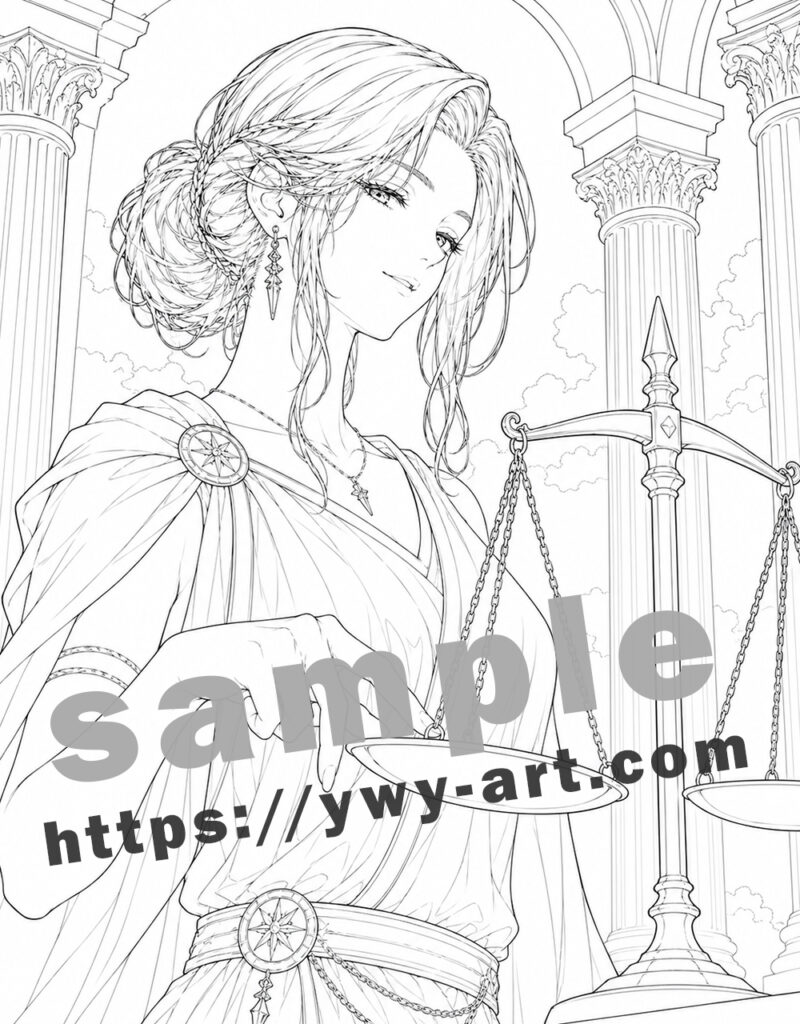
This page works beautifully with a solemn celestial palette. Ivory, antique gold, silver, pale blue, charcoal, pearl gray, and soft white can create a sacred judgment atmosphere. The Judgment Scales should remain the visual center, so the metal edges and hanging chains need clean contrast.
For the scales, antique gold gives a warmer divine feeling, while silver makes the artifact feel colder and more impartial. Either works well. You can also combine them: gold for the main frame, silver for the bowls or chain details. This creates a layered sacred-metal look.
If the illustration includes gemstones, halos, tablets, or light behind the scales, those can be colored with pale blue, white, or soft lavender. These cooler tones help separate Themis from warmer gods connected to fire, sun, or harvest. Her world should feel measured and clear.
Themis’ clothing works well in white, cream, pale gray, or muted blue. Strong red or heavy purple may make the mood too emotional, so restrained tones often suit her better. Small gold accents can show her divine authority without making the piece feel overly decorative.
The background can stay calm and spacious. Soft gradients, faint stars, marble-like shadows, or temple-like structures can support the theme without stealing attention. The key is visual balance. Since the artifact itself is about balance, the whole coloring approach should avoid making one area too noisy.
Quick Creative Reference
| Element | Creative Direction |
|---|---|
| Best For | Justice mythology, divine law, oracle themes, sacred balance, legal symbolism |
| Visual Keywords | Themis, Judgment Scales, divine order, balance, prophecy, law, sacred justice |
| Mood | Solemn, calm, wise, impartial, ancient, quietly severe |
| Recommended Colors | Ivory, antique gold, silver, pearl gray, pale blue, charcoal, soft white |
| Main Focus | The scales as a symbol of divine law, balance, truth, and unavoidable consequence |
| Coloring Tip | Keep both sides of the scales visually clear and balanced, using subtle highlights on the chains and bowls so the artifact reads immediately. |
Compare with Similar Deities
| Name | Mythology | Main Domains | Overall Image |
|---|---|---|---|
| Themis | Greek | Divine order, sacred law, prophecy, balance, rightful custom | An ancient Titaness who represents the deep order that makes justice and lawful rule possible |
| Dike | Greek | Justice, moral order, human fairness, legal consequence | A more direct personification of justice, often linked to human society and righteous judgment |
| Nemesis | Greek | Retribution, balance, punishment of arrogance | A goddess who restores balance when pride, excess, or injustice goes too far |
| Ma’at | Egyptian | Truth, cosmic order, justice, balance, harmony | An Egyptian goddess of truth and universal order, often symbolized by the feather used in judgment of the dead |
Closing
Themis Judgment Scales is a strong artifact piece because it makes justice feel ancient instead of modern and procedural. The scales are not just a legal symbol here. They are a divine instrument for measuring truth, consequence, and the balance of the world itself. Themis does not need to raise her voice. She only has to let the scales settle, and suddenly everything has weight.
Step into the world of mythology..
Available on Amazon Mythology Artifacts Series: Symbols of Power Coloring Book Open in a new tab
















































コメント