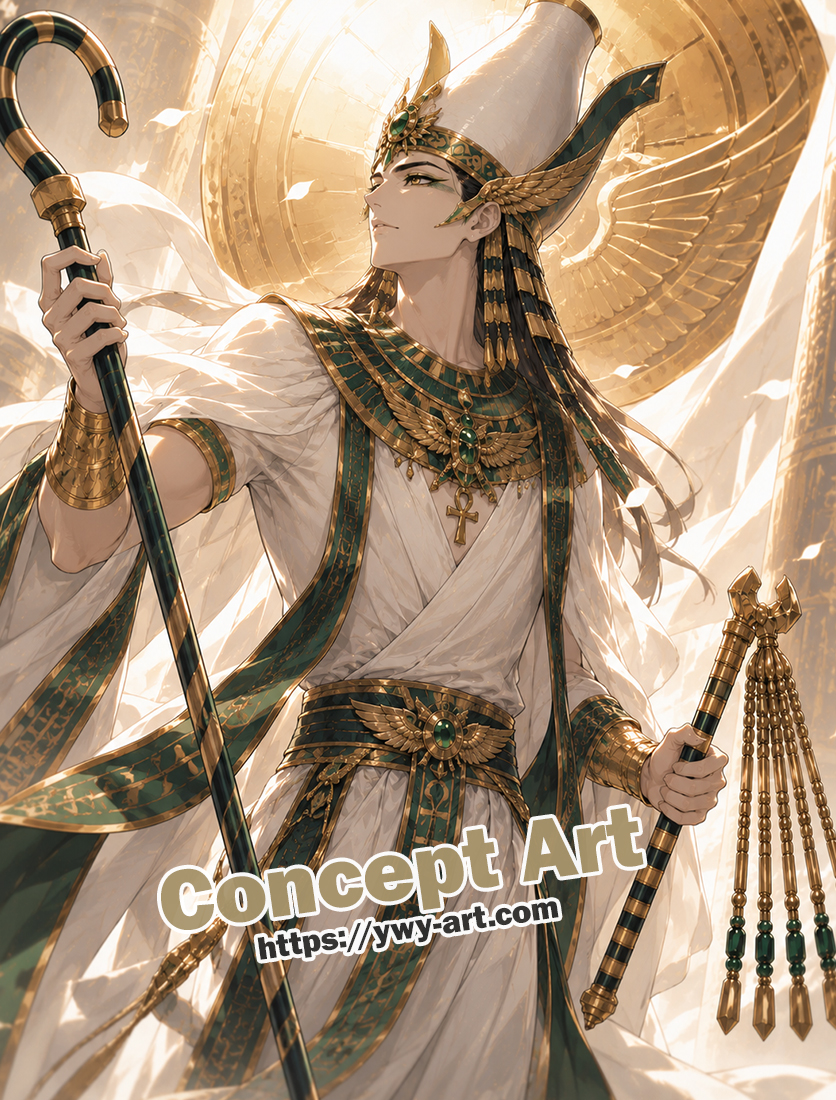
Osiris Crook and Flail
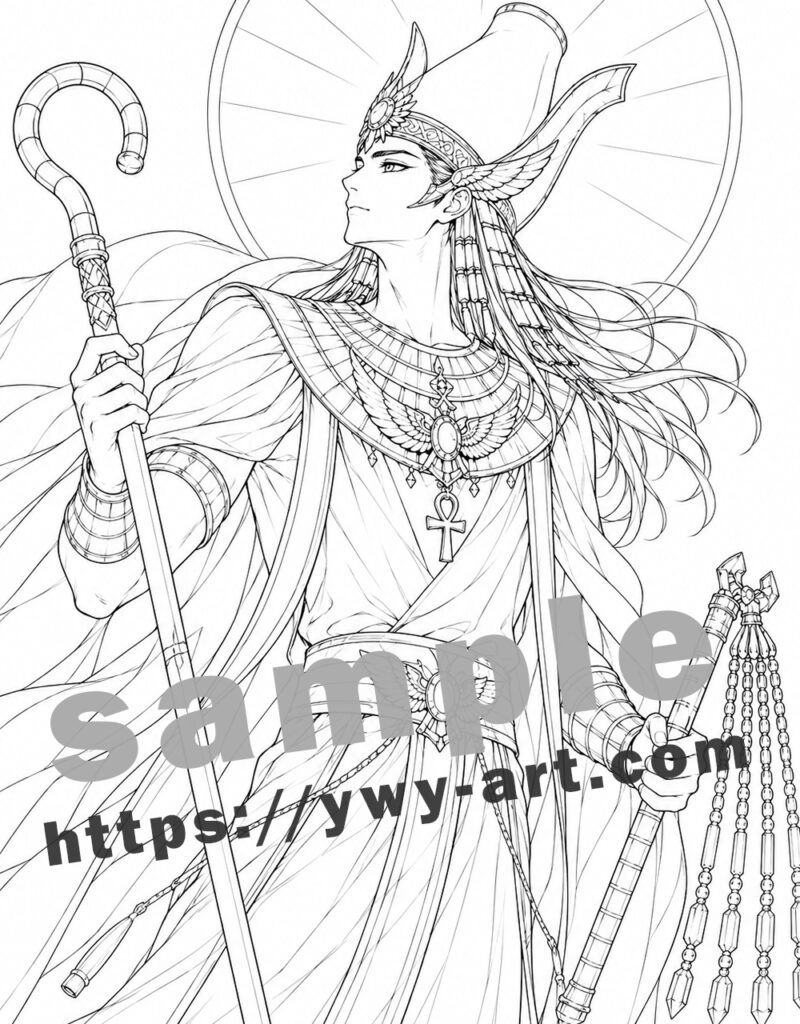
Osiris is not only a god of the dead. He is a king who was broken, restored, and transformed into something greater than ordinary kingship. He stands at the center of death, resurrection, agriculture, judgment, and royal continuity. In this illustration, the Crook and Flail become the central artifacts, held as sacred symbols of rule and protection. The scene feels calm and golden, but honestly, there is a deep sadness underneath that beauty. Osiris rules because he has already passed through loss.
Basic Profile
| Name | Osiris |
|---|---|
| Mythology | Egyptian Mythology |
| Gender | Male |
| Region | Ancient Egypt, especially Abydos, Busiris, funerary temples, agricultural lands, and the underworld |
| Era | Ancient Egyptian religious tradition, from early dynastic belief through later temple worship |
| Domain | Afterlife, resurrection, kingship, fertility, agriculture, judgment of the dead, renewal |
| Symbol | Crook, flail, atef crown, mummy wrappings, green skin, djed pillar, throne, wheat, ankh |
| Culture / Religion | Ancient Egyptian religion |
| Main Role | Lord of the underworld and divine king of resurrection and renewal |
| Associated Deity | Isis, Horus, Seth, Nephthys, Anubis, Ra, Ma’at, Thoth |
| Common Depiction | A mummiform king wearing the atef crown and holding the crook and flail across his chest |
| Alignment | Regal, mournful, fertile, resurrected, protective, judging, and deeply sacred |
Overview
Osiris is one of the most important gods in Egyptian mythology because his story gives shape to one of the deepest hopes in ancient Egyptian religion: death does not have to be the end. He is a murdered king, a restored body, a ruler of the afterlife, and a symbol of life returning from darkness.
His myth begins with kingship. Osiris is imagined as a wise ruler who brings order, agriculture, and civilized life. But his brother Seth murders him, and in many versions, his body is hidden, trapped, or cut apart. Isis searches for him, mourns him, and restores him through devotion and magic. From that restoration comes Horus, the son who will challenge Seth and continue the royal line.
Osiris does not simply return to rule Egypt in the ordinary world. Instead, he becomes lord of the dead. That transformation is important. His kingship moves from the visible throne to the unseen realm. He becomes the ruler who receives the dead, judges them, and offers the possibility of renewed life beyond the grave.
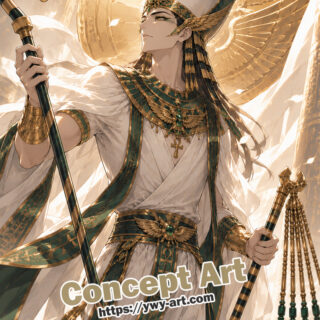
In this artwork, the Crook and Flail are not casual accessories. They are the visual language of divine kingship. Osiris holds them as symbols of care and authority, guidance and discipline, fertility and rule. The bright temple-like light gives the whole scene a sacred atmosphere, as if the viewer is standing before a living icon of afterlife kingship.
The Artifact: Crook and Flail
The crook and flail are among the most famous symbols of Egyptian rulership. They are strongly associated with pharaohs and with Osiris. The crook resembles a shepherd’s staff, suggesting guidance, protection, and the ruler’s duty to care for the people. The flail is more complex, often interpreted as a symbol of authority, fertility, agricultural abundance, or disciplinary power.
Together, the two objects create a balanced image of kingship. A ruler must guide, but also command. He must protect, but also maintain order. He must nourish the land, but also defend the structure that allows life to continue. That is why the crook and flail work so well for Osiris. He is both a dead king and an eternal ruler.
The crook connects Osiris to pastoral care. It suggests a king who gathers, leads, and protects. This matters because Egyptian kingship was not only about domination. It was also about maintaining Ma’at: truth, balance, and cosmic order. The ruler was expected to keep the land aligned with divine order.
The flail brings a different energy. Its form can suggest harvest, threshing, or the force needed to separate grain from husk. That agricultural association fits Osiris very well because he is closely connected to vegetation, fertility, and the annual renewal of life through the Nile and the fields. The flail therefore carries both royal and agricultural meaning.
In this illustration, the artifacts are held with calm confidence. They do not need motion to feel powerful. Their meaning is already ancient. The crook and flail tell us that Osiris’ authority is not based on shouting, conquest, or temporary victory. It is rooted in sacred continuity.
Mythological Background
The myth of Osiris, Isis, Seth, and Horus is one of the core stories of Egyptian religion. Seth murders Osiris, often out of jealousy or desire for power. Isis searches for Osiris and uses her magic to restore him long enough to conceive Horus. This makes Horus the living heir, while Osiris becomes the divine ruler of the dead.
This story gives Egyptian kingship a powerful mythic pattern. The living pharaoh is associated with Horus, the rightful son and ruler on earth. The dead king is associated with Osiris, the transformed ruler of the afterlife. In this way, death becomes part of royal continuity rather than a complete break.
Osiris is also closely linked to the agricultural cycle. Just as grain is buried in the earth and later rises as new growth, Osiris is killed, hidden, and renewed. This symbolism made him deeply connected to fertility, the Nile, and the hope that life could return after apparent destruction.
The djed pillar, another major symbol of Osiris, represents stability and endurance. It is often associated with his backbone or with the idea of lasting support. This adds another layer to the crook and flail. Osiris is not only restored; he becomes the stable center of afterlife order.
In funerary belief, Osiris presides over the judgment of the dead. The deceased hopes to become “an Osiris,” meaning to share in his resurrection and blessed afterlife. This is one of the reasons Osiris became so beloved. His myth turns death from pure terror into a passage with structure, judgment, and hope.
Symbolism and Meaning
The Crook and Flail represent kingship as responsibility. The crook guides and protects. The flail commands and separates. Together, they show that rule is not a single emotion or action. It is care, discipline, fertility, judgment, and continuity held in balance.
For Osiris, these symbols also carry the weight of death and restoration. He does not hold them as a living conqueror only. He holds them as one who has been murdered and remade. That gives the artifacts a solemn feeling. They are not trophies. They are signs that legitimate power can survive even death.
The crook can also be read as a symbol of gathering souls. As lord of the afterlife, Osiris receives the dead and rules over their passage. The shepherd-like shape becomes more than a pastoral tool. It suggests guidance through the unseen world.
The flail, with its hanging strands, may suggest harvest and transformation. Grain must be cut, beaten, separated, and prepared before it becomes food. Osiris’ own myth follows a similar symbolic structure: breaking, mourning, restoration, and renewed life. It is not gentle, but it leads somewhere.
The golden atmosphere of the image reinforces sacred kingship, while the white garments and green accents can connect to purity, resurrection, and the fertile Nile world. Osiris is regal, but not distant in the same way as Ra. His power feels rooted in death becoming life again.
Coloring Notes
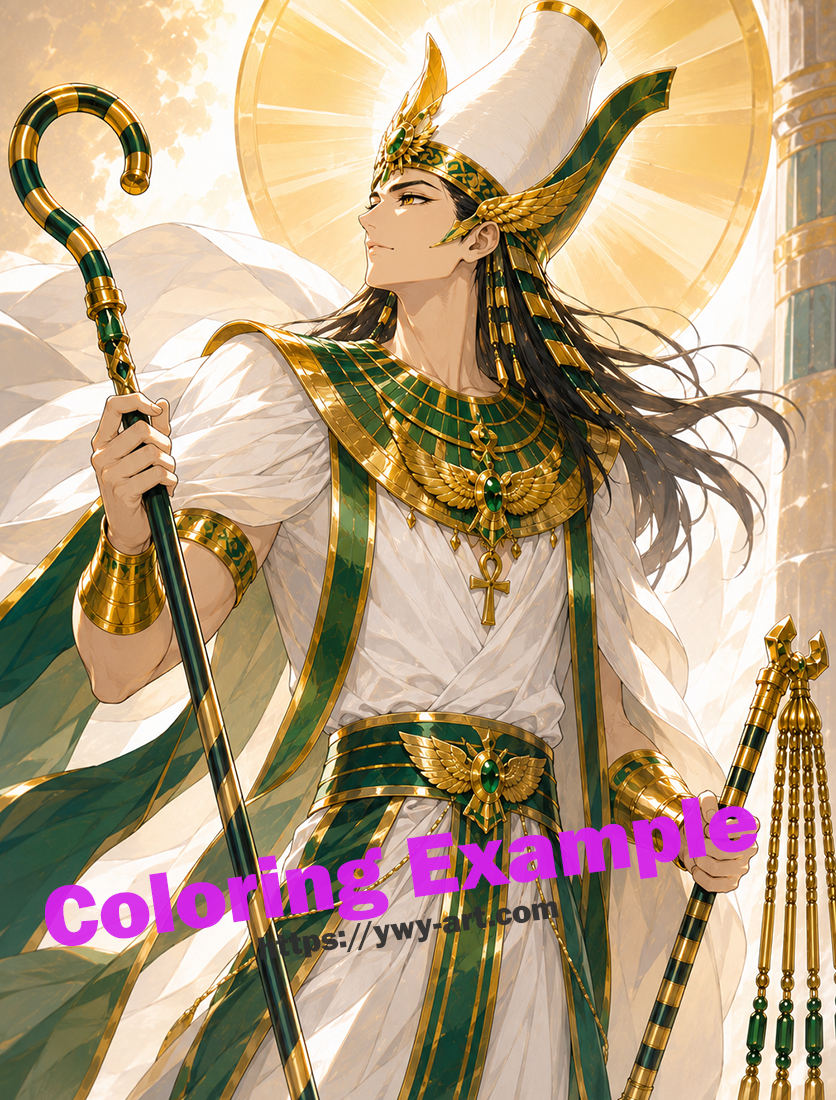
This page works beautifully with an Egyptian royal-afterlife palette. Antique gold, ivory, deep green, lapis blue, warm sand, black, and soft white can create a strong Osiris atmosphere. The crook and flail should remain visually clear, so their gold and dark details need strong contrast.
For the crook, a dark green or black handle with gold bands works well. This keeps the object elegant and readable. The curved top can receive brighter gold highlights to show its sacred authority. If there are engraved details, soft brown shadows will help them stand out without making the artifact too heavy.
For the flail, gold beads, dark cords, and green jewel accents can create a rich ceremonial look. The hanging strands should stay separated enough in color so the shape remains easy to read. Small highlights on the bead ends will make the artifact feel polished.
Osiris’ clothing can stay white or ivory with green and gold trim. White fabric is especially effective because it recalls mummy wrappings and temple purity without making the figure feel lifeless. Green accents are useful because Osiris is strongly connected with regeneration and fertile life.
The background can use warm gold, pale sand, and soft temple light. Blue accents in jewelry or ornaments will balance the warmth and give the scene a classic Egyptian richness. The key is to keep the strongest visual attention on the crook, flail, crown, and chest ornaments, since those areas carry the royal symbolism.
Quick Creative Reference
| Element | Creative Direction |
|---|---|
| Best For | Egyptian afterlife themes, divine kingship, resurrection symbolism, royal artifacts, sacred authority |
| Visual Keywords | Osiris, crook and flail, afterlife king, resurrection, green, gold, ankh, djed, throne |
| Mood | Regal, solemn, sacred, hopeful, ancient, restored |
| Recommended Colors | Antique gold, ivory, deep green, lapis blue, warm sand, black, soft white, bronze |
| Main Focus | The crook and flail as symbols of guidance, authority, fertility, and eternal kingship |
| Coloring Tip | Keep the crook and flail clearly separated from the white fabric by using strong gold highlights and darker handle shadows. |
Compare with Similar Deities
| Name | Mythology | Main Domains | Overall Image |
|---|---|---|---|
| Osiris | Egyptian | Afterlife, resurrection, kingship, fertility, judgment of the dead | A murdered and restored king who rules the afterlife and offers hope of renewal beyond death |
| Horus | Egyptian | Kingship, sky, protection, royal legitimacy | The living royal heir who restores order by challenging Seth and continuing Osiris’ line |
| Hades | Greek | Underworld, the dead, hidden wealth, final order | A stern ruler of the dead, more focused on underworld sovereignty than resurrection and fertility |
| Dionysus | Greek | Wine, ecstasy, transformation, fertility, death and return motifs | A god of ecstatic transformation whose myths sometimes echo death, rebirth, and life-force renewal |
Closing
Osiris Crook and Flail is a strong artifact piece because it makes kingship feel sacred, wounded, and eternal at the same time. The crook guides, the flail commands, and together they show a ruler whose authority continues beyond death. Osiris does not rule because nothing harmed him. He rules because he was broken, restored, and transformed into the lord of renewal itself.
Step into the world of mythology..
Available on Amazon Mythology Artifacts Series: Symbols of Power Coloring Book Open in a new tab
コメント