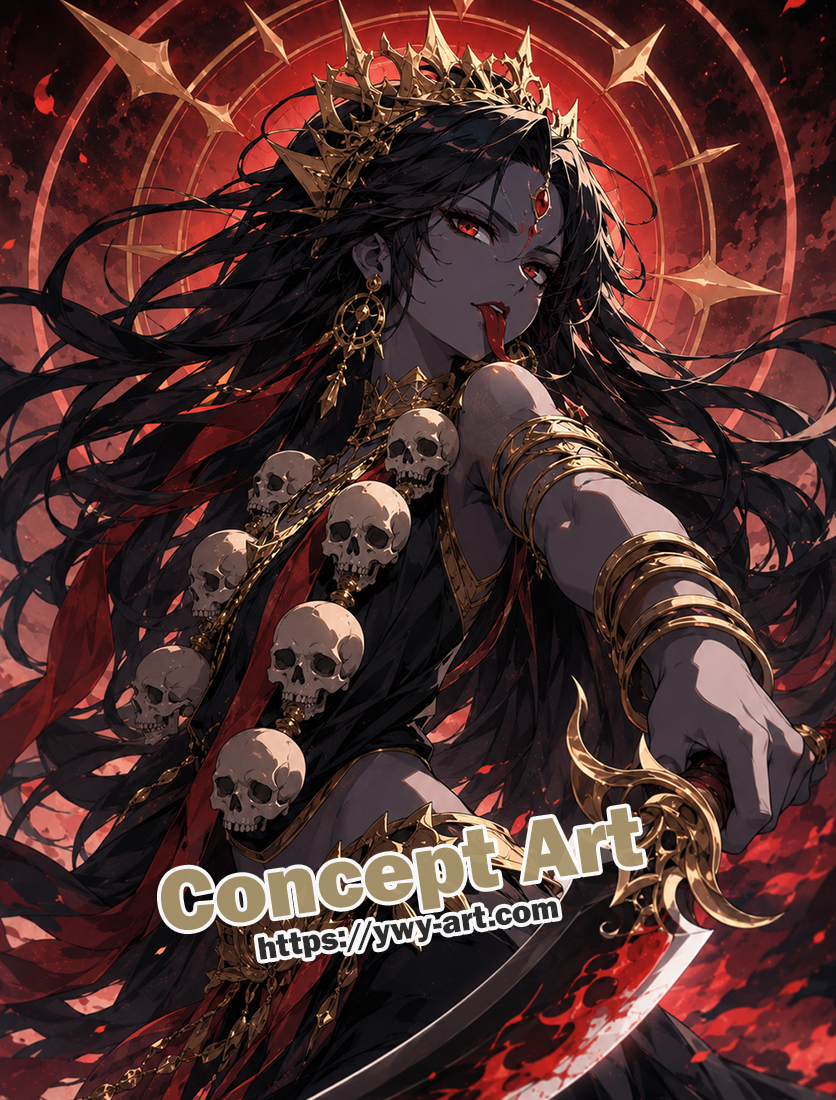
Kali Skull Garland Blade
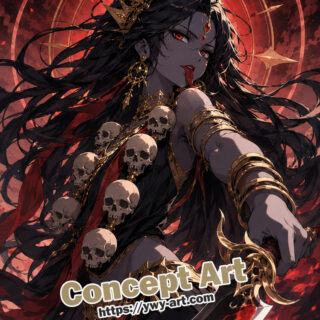
Kali is not a goddess who can be made soft just to make her easier to understand. She is time, death, destruction, protection, liberation, and the terrifying compassion that cuts away illusion. In this illustration, the Skull Garland Blade becomes the central artifact, flashing across the scene while skulls, red light, and dark hair swirl around her. It feels fierce, almost overwhelming, but honestly, that intensity is exactly what makes Kali so powerful. She does not destroy because she is empty. She destroys what cannot be allowed to remain.
Basic Profile
| Name | Kali |
|---|---|
| Mythology | Hindu Mythology |
| Gender | Female |
| Region | India, especially traditions connected with Shaktism, fierce goddess worship, and tantric symbolism |
| Era | Ancient and medieval Hindu religious tradition, with continuing worship today |
| Domain | Time, death, destruction, protection, liberation, fierce motherhood, transformation, the ending of ego |
| Symbol | Skull garland, sword, severed head, lolling tongue, dark skin, cremation ground, red eyes |
| Culture / Religion | Hinduism, especially Shakta and Tantric traditions |
| Main Role | Fierce goddess who destroys evil, dissolves illusion, and reveals the power beyond fear |
| Associated Deity | Durga, Shiva, Parvati, Devi, Chamunda, Bhairava, Mahishasura-related goddess traditions |
| Common Depiction | A dark and fierce goddess with wild hair, skull garland, weapons, extended tongue, and a terrifying protective presence |
| Alignment | Fierce, protective, destructive, maternal, liberating, terrifying, and spiritually transformative |
Overview
Kali is one of the most intense and complex goddesses in Hindu tradition. At first glance, her imagery can feel frightening: skulls, blood, blades, darkness, and a wild expression that refuses calm beauty. But Kali is not simply a goddess of violence. She is a goddess of endings, and endings are not always evil. Sometimes something must be cut away before truth can appear.
Her name is often connected with time, and that gives her mythology a much deeper meaning. Time devours everything. Kingdoms fall, bodies age, pride collapses, and even beautiful things pass away. Kali represents that unavoidable force, but she also stands beyond it. She is terrifying because she reveals what people spend their lives trying not to see.
Kali is also deeply connected with protection. This may seem contradictory, but it is central to her power. She destroys demons, ego, ignorance, and forces that threaten cosmic balance. Her fierceness is not random cruelty. It is protective ferocity. Like a mother who becomes terrifying when her child is threatened, Kali can appear monstrous to those who endanger the sacred.
In this artwork, the Skull Garland Blade gathers her fierce symbolism into one dramatic object. The blade cuts across the composition with blood-red motion, while the skull garland shows the nearness of death and the stripping away of vanity. The red halo behind her gives the scene a ritual heat, almost like the viewer is looking into a moment of divine wrath.
The Artifact: Skull Garland Blade
The Skull Garland Blade is a creative artifact built from two of Kali’s strongest symbols: the cutting blade and the skull garland. The blade represents severing. It cuts through demons, illusion, ego, attachment, and false identity. In Kali’s hands, a sword or curved blade is not only a weapon. It is a tool of liberation.
The skull garland is equally important. Kali is often shown wearing a garland of skulls or severed heads. This image can be shocking, but symbolically it points toward the destruction of ego and the reality of mortality. Every skull was once a face, a name, a story, a self-image. Kali wears them because no identity escapes time.
When these two symbols are combined into the idea of the Skull Garland Blade, the artifact becomes a weapon that carries memory of what has already been cut away. It is not a clean heroic sword. It is a blade of endings. It holds the residue of fear, death, and transformation.
The curved shape of the blade in this illustration gives it a ritual feeling. It does not look like a standard battlefield sword. It feels ceremonial, almost like an instrument used to cut through spiritual darkness. The red stains along the edge make it impossible to treat the artifact as decorative. This blade has acted.
Mythological Background
Kali appears in several important goddess traditions, often emerging in moments when ordinary divine force is not enough. In the Devi Mahatmya, fierce goddess forms arise to battle demons who threaten cosmic order. Kali is closely associated with the terrifying energy of the Goddess when destruction becomes necessary.
One famous story connects Kali with the battle against the demon Raktabija. Every drop of his blood that falls to the ground creates another demon like him. This makes him nearly impossible to defeat by ordinary combat. Kali solves the problem by drinking the blood before it can touch the earth, preventing the demon from multiplying. The image is violent, but mythologically precise: she stops evil at its source.
Kali is also closely linked with Shiva. In some stories, her destructive dance becomes so fierce that it threatens to consume everything. Shiva lies beneath her feet, and when she realizes she has stepped on him, her tongue extends in shock or shame. This famous image shows the relationship between dynamic divine energy and still consciousness. Kali moves, burns, cuts, and dances. Shiva receives, witnesses, and stabilizes.
Kali is sometimes understood as a fierce form of Devi, Parvati, or Durga, depending on tradition. This is important because she is not separate from divine motherhood. Her terrifying appearance is one face of the Great Goddess. She can be dreadful and compassionate at the same time, because true protection is not always gentle.
In Tantric traditions, Kali can represent liberation from fear, ego, and conventional illusion. Her cremation-ground imagery reminds devotees that the body is temporary and that clinging to false identity causes suffering. To face Kali is to face what cannot be controlled.
Symbolism and Meaning
The Skull Garland Blade represents the cutting away of illusion. That is the central idea. Kali’s blade does not only cut flesh in mythic battle. It cuts pride, attachment, fear, and the belief that the ego is permanent. This makes the artifact terrifying, but also spiritually powerful.
The skull garland represents mortality and language. In some interpretations, the severed heads or skulls can also relate to letters, sound, or the many forms of manifested existence. Whether read as death, speech, or ego, the garland shows that Kali wears what the world fears.
The red color in the image suggests blood, life force, rage, and ritual power. Red is not only violence here. It is energy. It is the heat of transformation. Kali’s red background makes the whole scene feel alive, dangerous, and sacred at once.
Her dark body and black hair create a strong contrast with the gold ornaments and pale skulls. Darkness here should not be read as emptiness. It is the vast unknown, the womb of time, the space where forms dissolve. Kali is dark because she contains what comes before and after visible life.
The extended tongue is one of Kali’s most recognizable features. It can suggest blood-drinking fury, shock, shame, or the rawness of divine presence beyond polite beauty. In the artwork, it adds a disturbing but important emotional note. Kali is not trying to appear acceptable. She appears as truth without disguise.
Coloring Notes
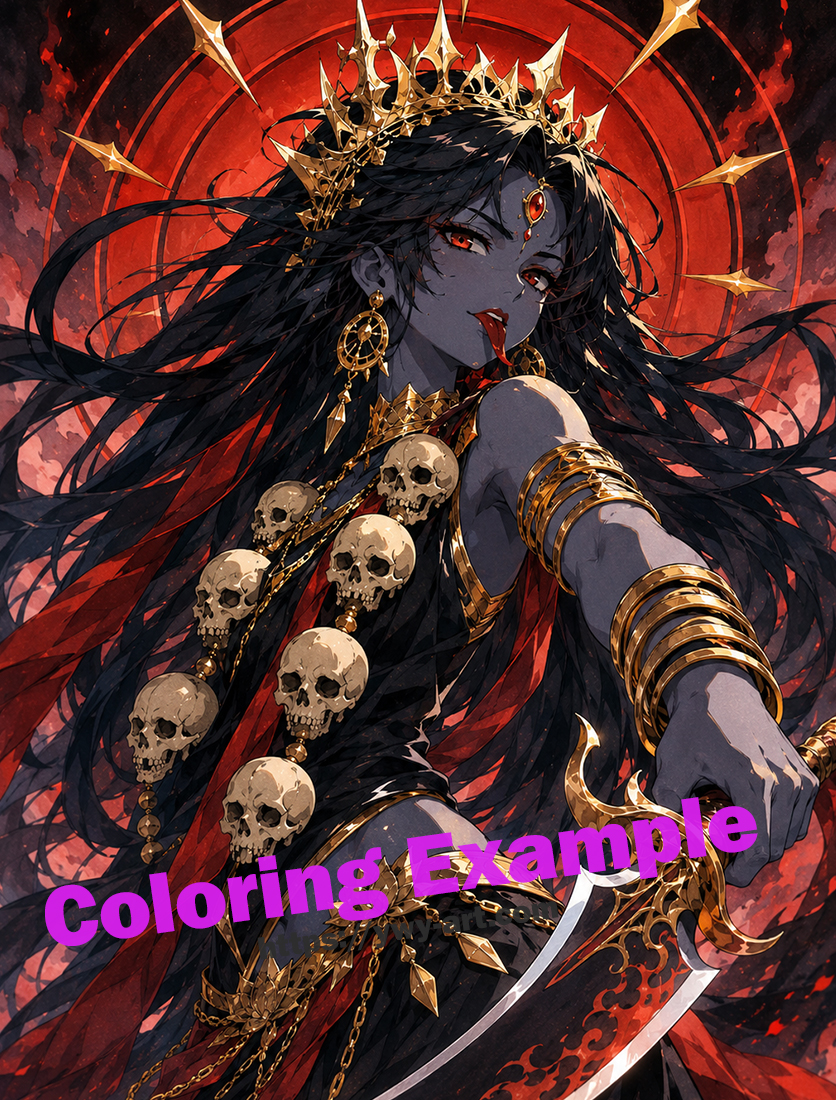
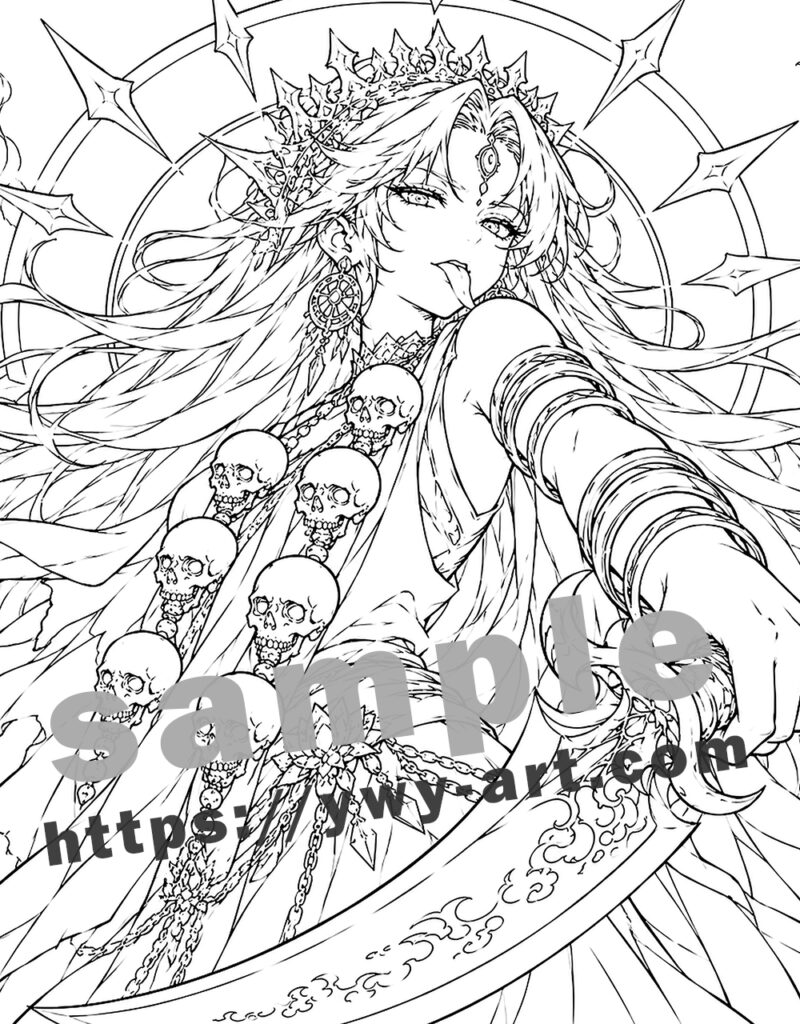
This page works best with a fierce red, black, and gold palette. Deep crimson, blood red, black, charcoal, antique gold, bone white, and dark violet can create a powerful Kali atmosphere. The Skull Garland Blade should remain the main visual strike, so the blade edge and blood-red movement need sharp contrast.
For the blade, use cool silver or dark steel with bright highlights along the cutting edge. The blood or red energy can be colored with crimson, deep red, and small touches of brighter scarlet. Keeping the blade itself partly clean will make the red marks feel stronger.
The skull garland should stand out clearly. Bone white, ivory, gray-brown shadows, and small dark eye sockets will work well. Avoid making every skull equally dark, or they may blend into the hair and clothing. A few strong highlights will make the garland readable.
Kali’s clothing can use black, deep red, dark purple, and gold accents. Gold jewelry should catch light, but not overpower the red background. The crown can be colored in antique gold with darker shadows between the spikes to keep the silhouette sharp.
For the skin, a deep blue-black, charcoal violet, or dark gray-purple can create a strong mythic look. Red reflections from the background can be added subtly to the face, arms, and blade hand. The eyes should be intense, using red or glowing warm highlights if the design allows it.
Quick Creative Reference
| Element | Creative Direction |
|---|---|
| Best For | Fierce goddess themes, dark divine feminine power, destruction and liberation, demon-slaying imagery |
| Visual Keywords | Kali, Skull Garland Blade, red moon, skulls, curved blade, blood, wild hair, divine wrath |
| Mood | Terrifying, sacred, fierce, liberating, intense, darkly beautiful |
| Recommended Colors | Crimson, black, charcoal, antique gold, bone white, dark violet, deep red, steel gray |
| Main Focus | The blade as a symbol of severing illusion, destroying evil, and transforming fear into liberation |
| Coloring Tip | Keep the skulls lighter than the hair and the blade edge brighter than the red background so the main symbols stay readable. |
Compare with Similar Deities
| Name | Mythology | Main Domains | Overall Image |
|---|---|---|---|
| Kali | Hindu | Time, death, destruction, protection, liberation, fierce motherhood | A terrifying and compassionate goddess who destroys evil, cuts illusion, and reveals the truth beyond fear |
| Durga | Hindu | War, protection, divine feminine power, demon-slaying | A heroic warrior goddess who defeats demons and protects cosmic order with majestic force |
| Chamunda | Hindu | Death, cremation grounds, fierce protection, demon destruction | A skeletal and terrifying goddess form associated with death, fearlessness, and the destruction of demons |
| Sekhmet | Egyptian | War, plague, healing, solar wrath, royal protection | A lioness goddess whose fiery destruction protects divine order and can also become healing power |
Closing
Kali Skull Garland Blade is a strong artifact piece because it does not soften the meaning of destruction. The blade cuts, the skulls remember, and the red light turns the whole image into a ritual of endings. But Kali is not empty violence. She is the fierce force that destroys illusion, breaks false pride, and stands beyond fear. Her blade is terrifying because it is honest, and that honesty is exactly where her power lives.
Step into the world of mythology..
Available on Amazon Mythology Artifacts Series: Symbols of Power Coloring Book Open in a new tab








コメント