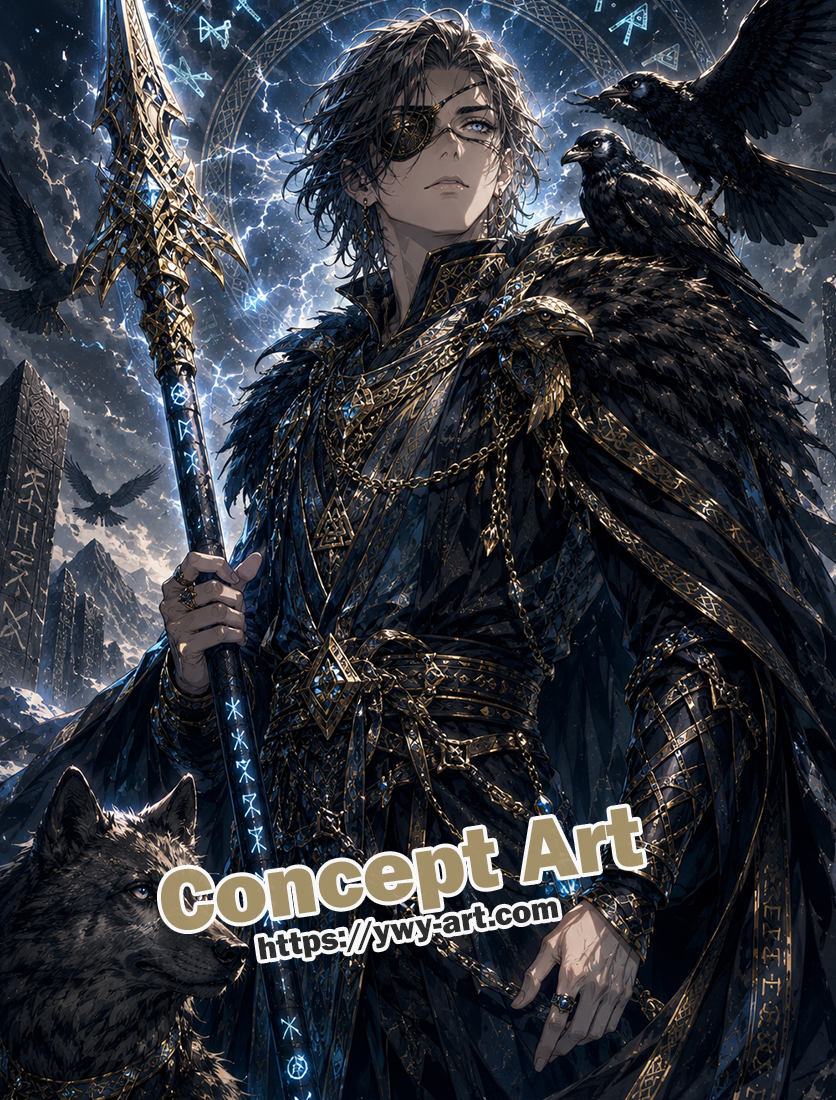
Odin Gungnir Spear
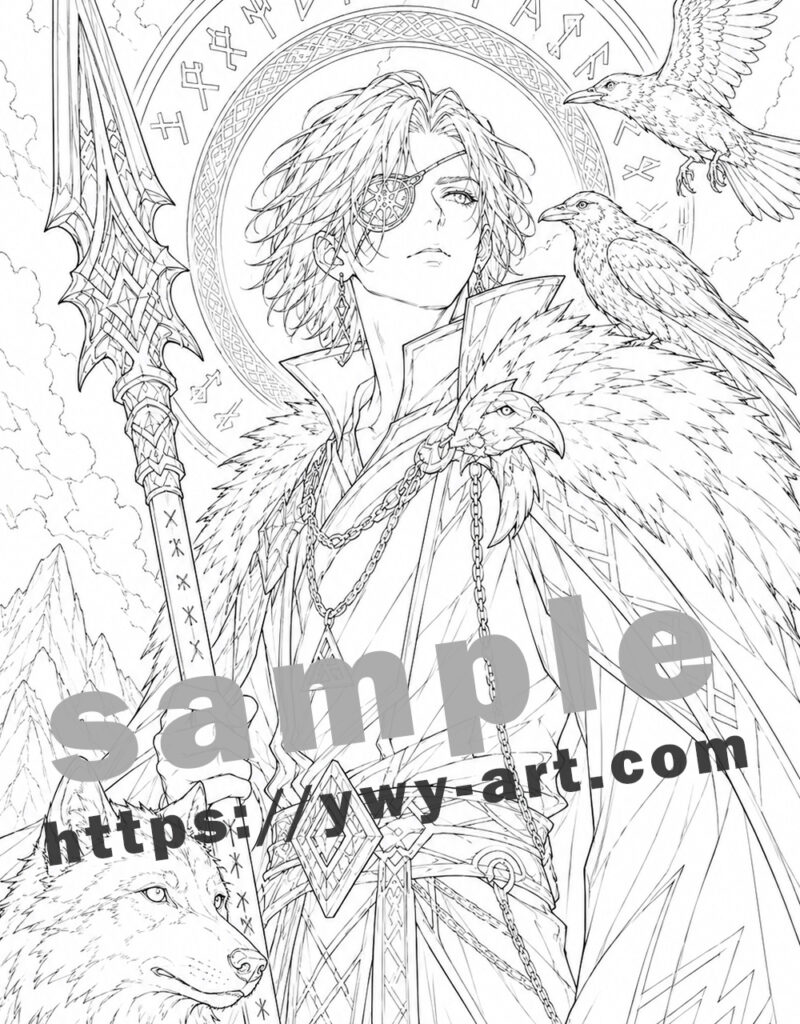
Odin stands in this artwork like a god who has already paid the price for what he knows. The spear rises beside him, marked with runes and cold light, while ravens gather around his shoulders and a wolf waits below. The whole scene feels sharp, watchful, and heavy with fate. This is not just a warrior holding a weapon. It feels like a ruler, a seeker, and a sacrifice all standing in the same body.
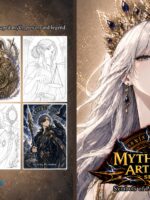
This piece belongs to the Mythology Artifacts Series, a coloring book collection focused on divine weapons, sacred relics, and symbolic objects from world mythology. Here, the central artifact is Gungnir, Odin’s legendary spear from Norse mythology. It is a weapon of kingship, battle, oath, prophecy, and divine authority — and honestly, it may be one of the most intimidating artifacts in the whole series.
Basic Profile
| Name | Odin |
|---|---|
| Mythology | Norse mythology |
| Gender | Male deity |
| Region | Scandinavia and the wider Germanic world |
| Domain | Wisdom, war, kingship, magic, poetry, death, prophecy, and sacrifice |
| Artifact | Gungnir Spear |
| Associated Symbol | Runes, ravens, wolves, the one eye, the spear, the gallows, Valhalla |
| Main Role | The All-Father, a god of wisdom, war, magic, and fate |
| Common Depiction | A one-eyed god with a spear, ravens, wolves, a cloak, and a commanding but mysterious presence |
| Overall Image | Wise, severe, prophetic, battle-worn, and deeply connected to fate |
Overview
Odin is one of the central gods of Norse mythology. He is often called the All-Father, but that title can make him sound simpler than he really is. Odin is not only a ruler. He is a wanderer, a war god, a magician, a poet, a seeker of forbidden knowledge, and a god who is willing to suffer for wisdom.
That is what makes Odin so different from a straightforward king of the gods. He does not simply sit on a throne and command the world from a distance. He searches. He sacrifices. He disguises himself. He crosses boundaries between life and death, gods and humans, wisdom and danger.
In this artwork, Odin is shown with a cold and commanding atmosphere. His one eye looks forward, the spear glows with runic power, and the ravens around him feel like living fragments of thought and memory. The image does not need a battle scene to feel intense. Odin’s presence alone already makes the air feel charged.
The Artifact: Gungnir Spear
Gungnir is Odin’s legendary spear, and it is one of the most important weapons in Norse mythology. In myth, it is often described as a weapon that never misses its mark. That idea makes Gungnir more than a sharp object. It becomes a symbol of certainty.
A spear is already a strong symbol in a warrior culture. It can be thrown, planted, raised, or used to claim authority. But Gungnir belongs to Odin, so its meaning becomes darker and more complex. It is tied to war, kingship, sacrifice, and the shaping of fate.
In this illustration, the spear is marked with glowing runes, giving it a magical and prophetic feeling. It does not look like an ordinary battlefield weapon. It looks like something carved with knowledge that should not be handled carelessly. The blue light along the shaft makes the spear feel cold, precise, and almost unavoidable.
The spear also connects to Odin’s role as a god of oaths and sacred violence. In Norse tradition, weapons were not just tools. They could carry vows, destinies, and divine approval. Gungnir feels like the kind of artifact that does not simply kill. It declares that an outcome has already been written.
Mythological Background
Odin’s mythology is full of sacrifice. One of the most famous stories says that he gave one of his eyes in exchange for wisdom from Mimir’s well. That single missing eye became one of his strongest visual symbols. It shows that Odin’s wisdom was not free. He paid for it with part of himself.
Another powerful myth tells how Odin hung himself on the World Tree, Yggdrasil, wounded by a spear, in order to gain knowledge of the runes. This is one of the most striking parts of his mythology. The god of wisdom does not simply receive knowledge as a gift. He suffers for it, almost like he must break himself open to reach what is hidden.
That connection makes the spear even more meaningful. Odin is both the god who holds the spear and the god who is wounded by a spear in his search for runic knowledge. Gungnir is not only a weapon pointed outward. It is also tied to sacrifice, pain, and initiation.
Odin’s ravens, Huginn and Muninn, are also essential to his image. Their names are often translated as Thought and Memory. They fly across the world and bring information back to him. In this artwork, the ravens are not just decorative birds. They are part of Odin’s mind moving through the world.
The wolf below the figure adds another Norse layer. Wolves are connected to danger, wilderness, battle, and fate. Odin is associated with wolves, and Norse myth also contains the terrifying figure of Fenrir, the great wolf connected to Ragnarök. So the wolf presence here quietly reminds us that Odin’s world is always moving toward an end.
Symbolism and Meaning
The strongest theme in this artwork is knowledge that comes with a cost. Odin’s one eye, the runic spear, the ravens, the wolf, and the stormy sky all point toward a god who understands that power is never clean or simple.
Gungnir represents inevitability. A spear that never misses does not only suggest accuracy. It suggests fate. Once thrown, once raised, once chosen, the path cannot easily be undone. That is why the spear feels so appropriate for Odin. He is a god who sees deeper than most, but even he cannot fully escape destiny.
The runes around the background strengthen this idea. Runes are not just letters in the mythic imagination. They are signs of hidden knowledge, magic, naming, memory, and power. When they glow around Odin, the scene feels less like a normal portrait and more like a ritual of fate.
The ravens create a sharp contrast with the bright blue magical light. Black feathers, cold lightning, and rune glow give the piece a beautiful but severe mood. It is dark, but not empty. It feels full of thought, warning, and old power.
Coloring Notes
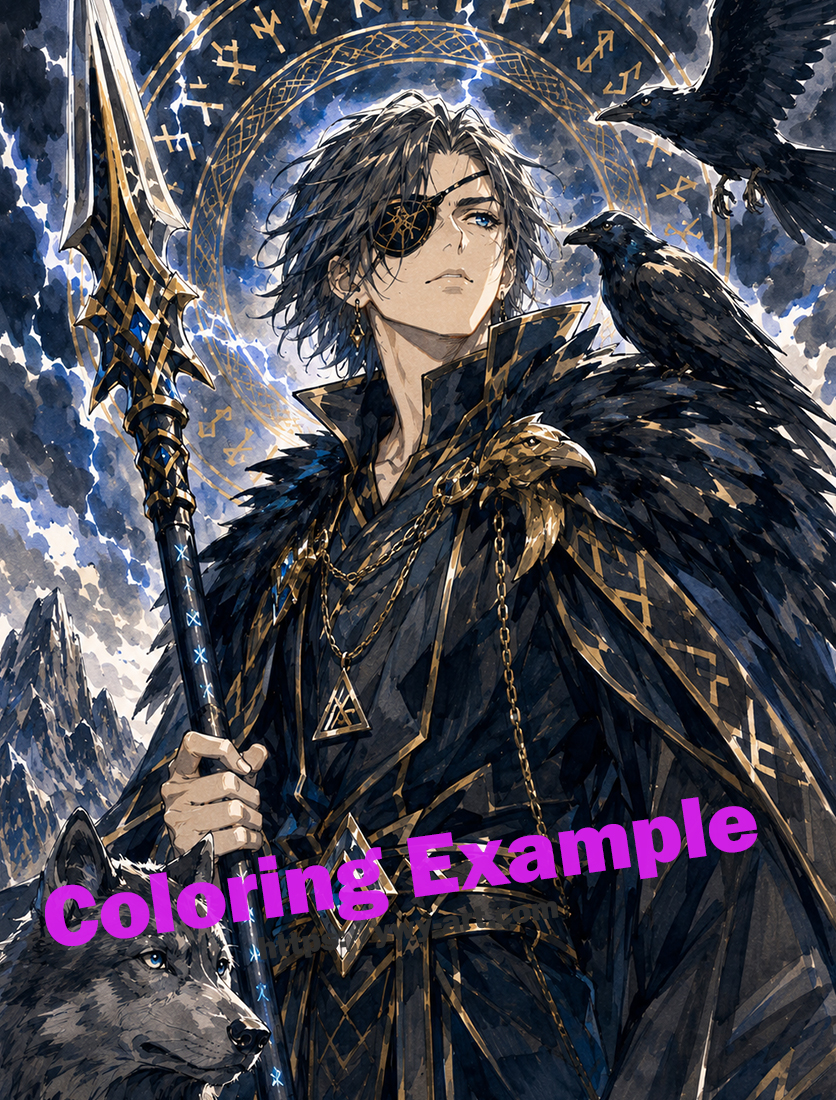
This page works especially well with a cold, dramatic palette. Deep navy, black, charcoal, blue-gray, icy blue, antique gold, and muted silver can create a strong Norse atmosphere. The key is to keep the image powerful without turning every detail into the same dark mass.
For Gungnir, the spear can be colored with dark steel, silver, blue highlights, or antique gold details. The glowing runes along the shaft are a perfect place for icy blue or pale cyan. If the rune light is kept bright, the spear will immediately become the center of the page.
Odin’s cloak and armor can use layers of black, dark blue, gray, and muted gold. Since the outfit is detailed, repeating the same small color group will help keep the design unified. Too many unrelated colors may weaken the severe mythic mood.
The ravens should not be colored as flat black. Try using charcoal, blue-black, violet-black, and small gray highlights along the wings and feathers. This will keep their shapes readable, especially against the stormy background.
The wolf can be colored in gray, ash brown, black-gray, or cold silver tones. Keeping the wolf slightly softer than Odin and the spear will help it support the scene without stealing attention.
For the background, storm clouds, snow-dark mountains, rune circles, and lightning can all work together. Deep blue-gray shadows with icy highlights will make the whole page feel cold and ancient. The runes can glow brighter than the sky, but they do not all need the same intensity. A few strong glowing marks will be enough.
Quick Creative Reference
| Element | Creative Direction |
|---|---|
| Gungnir Spear | Use dark steel, silver, antique gold, and icy blue rune light to make it feel legendary. |
| Runes | Pale blue, cyan, or cold white can create a magical and prophetic glow. |
| Ravens | Use charcoal, blue-black, violet-black, and small gray highlights for readable feathers. |
| Odin’s Cloak | Deep navy, black, charcoal, and muted gold keep the design severe and regal. |
| Wolf | Gray, ash brown, black-gray, or silver tones support the cold Norse atmosphere. |
| Overall Mood | Cold, prophetic, severe, regal, stormy, and fate-bound. |
Compare with Similar Deities
| Name | Mythology | Main Domains | Overall Image |
|---|---|---|---|
| Odin | Norse mythology | Wisdom, war, magic, prophecy, sacrifice | A one-eyed seeker of hidden knowledge who rules, wanders, sacrifices, and faces fate. |
| Zeus | Greek mythology | Sky, thunder, kingship, divine law | A ruler-god whose lightning represents command, judgment, and heavenly authority. |
| Thor | Norse mythology | Thunder, protection, strength, storms | A powerful protector whose hammer represents raw force and defense against chaos. |
| The Morrigan | Irish and Celtic mythology | War, fate, prophecy, death, sovereignty | A raven-linked war goddess who appears around battle, omens, and the fate of heroes. |
Coloring Variations
- Runic Storm Version: Use deep navy, charcoal, icy blue runes, and silver lightning for a dramatic magical atmosphere.
- Raven King Version: Focus on black feathers, antique gold details, pale skin, and dark blue shadows.
- Ancient Wanderer Version: Use weathered browns, muted gray, dark leather, bronze, and cold mountain tones.
- Prophecy Glow Version: Keep most of the figure dark, then make the spear runes and background symbols glow with pale blue light.
Closing
Odin Gungnir Spear is a coloring page about wisdom, sacrifice, war, and fate. The spear is not only a weapon. It is a sign of authority, prophecy, and the terrible certainty that comes with divine knowledge.
For colorists, this artwork offers a strong mix of dark feathers, glowing runes, storm clouds, cold metal, wolf fur, and Norse ornament. The best approach may be to choose one main light source first, probably the runes on Gungnir, and let the rest of the page build around that cold glow.
In the end, this piece shows Odin as more than a battle god. He is the one who sacrifices for wisdom, sends ravens across the world, walks beside wolves, and holds the spear that never misses. Gungnir stands at the center of the image like a line drawn through fate itself.
Step into the world of mythology..
Available on Amazon Mythology Artifacts Series: Symbols of Power Coloring Book Open in a new tab




コメント