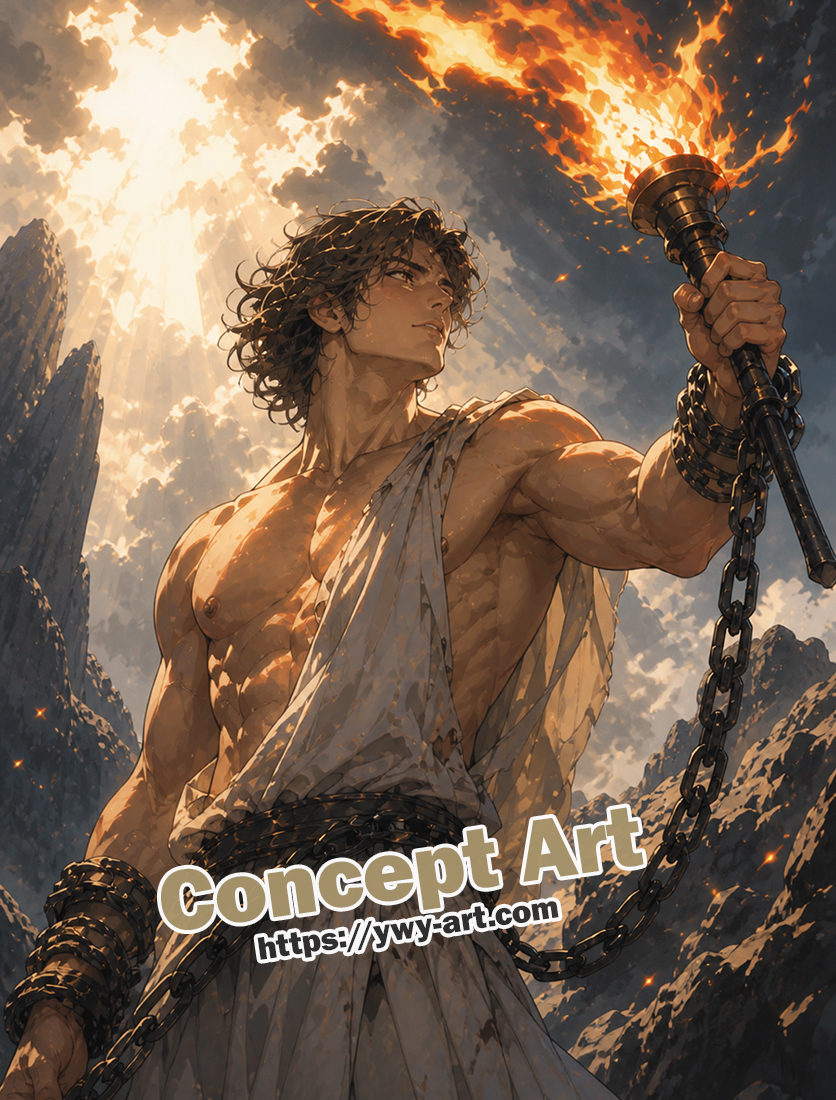
Prometheus Stolen Fire
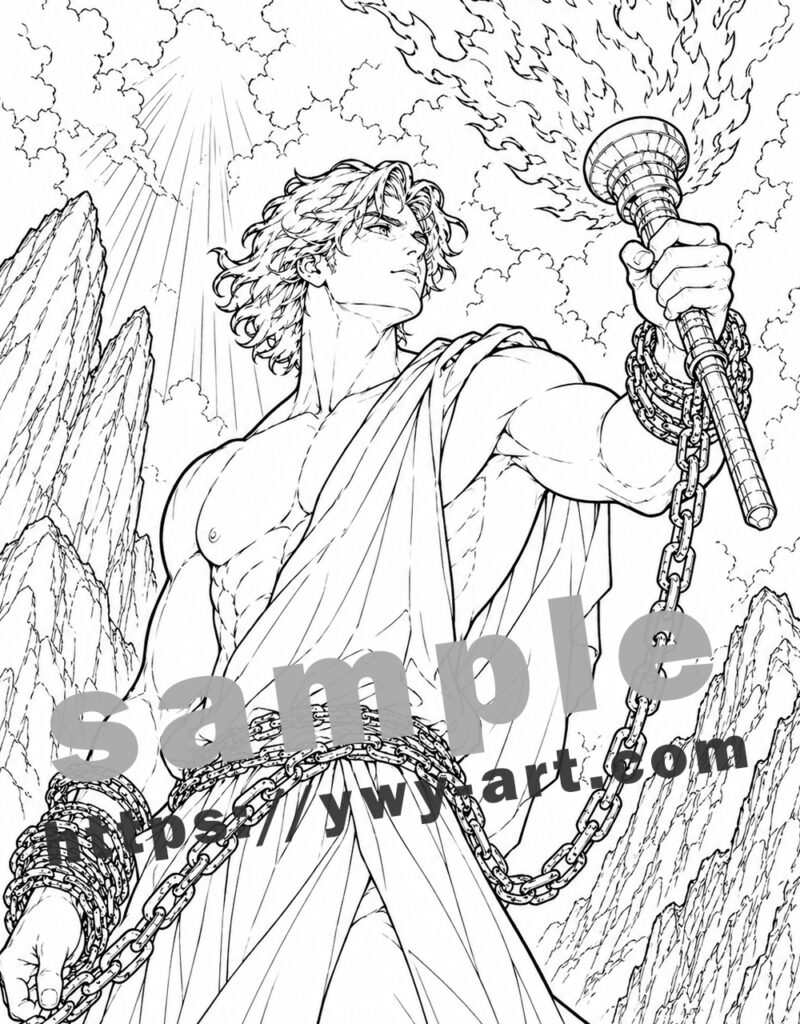
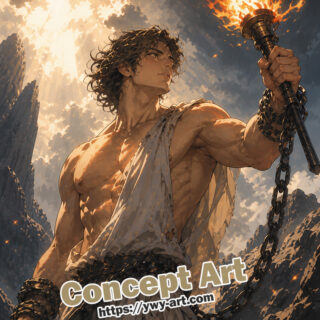
Prometheus is one of the most powerful figures in Greek mythology because his story feels strangely close to us. He is not only a Titan who tricks Zeus. He is the one who brings fire to humanity, and with it, the possibility of craft, survival, cooking, metalwork, light, and civilization itself. In this illustration, the Stolen Fire becomes the central artifact, raised against the sky while chains hang from his arm. Honestly, this one has a heroic sadness that really hits. The fire is beautiful, but it also carries the cost of defiance.
Basic Profile
| Name | Prometheus |
|---|---|
| Mythology | Greek Mythology |
| Gender | Male |
| Region | Greek mythic world, especially the early age of humans and the conflict between Titans and Olympian authority |
| Era | Titan generation and early human age under Zeus’ rule |
| Domain | Forethought, fire, human civilization, craft, rebellion, intelligence, sacrifice, suffering |
| Symbol | Torch, fire, chain, eagle, rock, fennel stalk, flame, human creation |
| Culture / Religion | Ancient Greek myth and later literary tradition |
| Main Role | Titan benefactor of humanity who steals fire from the gods |
| Associated Deity | Zeus, Epimetheus, Pandora, Athena, Hephaestus, Heracles, Oceanus |
| Common Depiction | A bound or defiant Titan carrying fire, often associated with chains, punishment, and a mountain or rock |
| Alignment | Rebellious, intelligent, compassionate, tragic, enduring, and deeply tied to human progress |
Overview
Prometheus belongs to the Titan generation, but he is very different from figures like Cronus or Atlas. His name is often interpreted as “forethought,” and that already tells us something important. Prometheus thinks ahead. He understands consequences, strategy, and the long future of humanity in a way many gods do not seem to care about.
His most famous act is stealing fire from the gods and giving it to humans. That single act changes everything. Fire is warmth in the cold. It is cooked food, protection from animals, light in darkness, and the beginning of craft. With fire, humans become more than fragile creatures waiting in the world. They begin to shape the world.
But this gift is not approved by Zeus. In many versions of the myth, Zeus withholds fire from humanity as part of a larger conflict over sacrifice, obedience, and divine authority. Prometheus breaks that order. He does not simply ask permission. He takes the flame and gives it away. That is why his story feels so charged: it is both theft and salvation.
In this artwork, the Stolen Fire is not small or hidden. Prometheus raises it high, almost like he is showing the sky what he has done. The chains remind us that the gift has consequences. The mountains and stormy light make the scene feel harsh and exposed. This is not a quiet act of charity. It is rebellion with the whole cosmos watching.
The Artifact: Stolen Fire
The Stolen Fire is less like an object and more like a divine force captured in human hands. In myth, Prometheus often steals fire by hiding it in a fennel stalk, a clever detail that fits his character perfectly. He does not defeat Zeus through strength. He wins through intelligence, timing, and a practical trick.
For this artifact series, the flame can be understood as the first sacred technology. It is a stolen light that becomes the foundation of human culture. Unlike a crown, shield, or weapon, this artifact spreads. Once fire is given to humanity, it cannot easily be taken back in the same way. It becomes knowledge.
That is what makes fire so dangerous to divine authority. A weapon can belong to one god. A torch can be passed from hand to hand. Fire multiplies. One flame lights another, then another, and soon the gift is everywhere. Prometheus does not only steal a thing. He changes the balance between gods and humans.
The chain attached to the torch in this illustration adds a strong visual idea. The fire gives freedom, but the giver is bound. The artifact therefore holds two opposite meanings at once: liberation for humanity and punishment for Prometheus. That tension is the heart of the myth.
Mythological Background
Prometheus’ conflict with Zeus begins before the theft of fire. In one famous story, Prometheus tricks Zeus during a sacrificial division. He prepares two portions: one with bones hidden under tempting fat, and another with good meat hidden inside an unattractive stomach. Zeus chooses the deceptive portion, and the myth explains aspects of human sacrifice and the division between gods and mortals.
After this conflict, Zeus withholds fire from humans. Prometheus then steals it and gives it back to them. The punishment is severe. Zeus orders Prometheus to be chained to a remote rock, where an eagle comes each day to eat his liver. Each night, the liver grows back, and the torment begins again. It is a punishment designed not only to hurt, but to repeat.
This endless suffering is what makes Prometheus such a powerful tragic figure. He knows pain will come, yet his gift remains. He cannot undo the fire. He cannot fully escape the consequences. But the world is changed because he acted. That gives his myth a strange dignity, even in torment.
Eventually, Heracles kills the eagle and frees Prometheus in many traditions. This rescue does not erase the suffering, but it gives the story a sense of completion. The punished benefactor is not forgotten forever. His endurance becomes part of the heroic and moral landscape of Greek myth.
Prometheus is also connected to the creation or shaping of humanity in some traditions. Later stories imagine him forming humans from clay, sometimes with Athena giving them life or spirit. This strengthens his role as a figure deeply tied to human existence. He is not only a thief of fire. He is almost a maker, teacher, and protector of mankind.
Symbolism and Meaning
The Stolen Fire represents knowledge that cannot be returned to ignorance. Once humans receive fire, they are changed. They can cook, forge, build, gather at night, and imagine a different future. Fire becomes the beginning of technology, and technology becomes one of the things that separates humans from the animals around them.
The flame also symbolizes dangerous progress. Prometheus’ gift is not purely safe. Fire warms, but it also burns. It protects, but it can destroy forests and cities. This makes the artifact more complex than a simple “gift of light.” It is power, and power always requires responsibility.
Prometheus himself represents compassion mixed with defiance. He sees human weakness and decides to act against Zeus’ command. That decision makes him heroic, but not in a clean and easy way. He steals. He deceives. He challenges divine order. Yet without that transgression, human life remains smaller and colder.
The chains in the image symbolize the cost of helping others when authority does not allow it. Prometheus gives freedom and receives captivity. That contrast is painful, and it is also why his myth has remained so compelling. He is punished for the thing that makes him most admirable.
The mountain setting adds another layer. Prometheus is isolated, placed high and far away, where suffering becomes visible but unreachable. The fire raised in his hand cuts through that isolation. Even chained, he still holds the symbol of what he gave to the world.
Coloring Notes
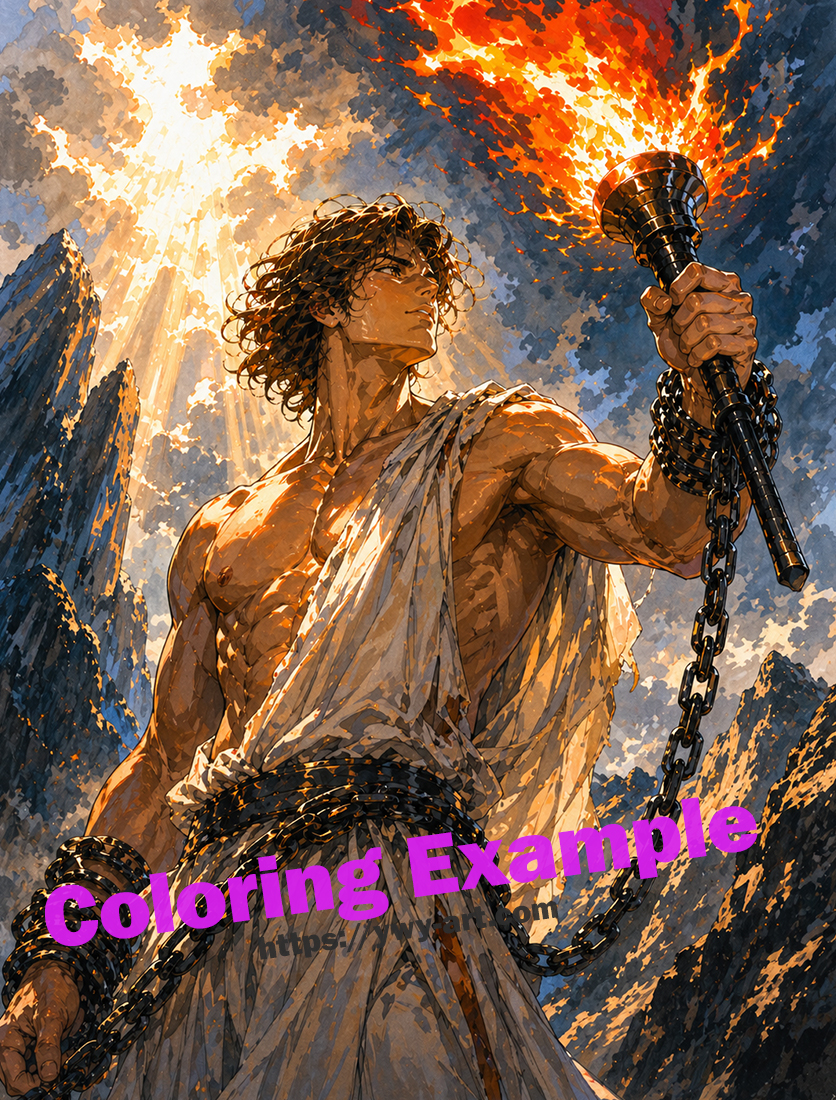
This page works beautifully with strong contrast between fire and stone. Deep gray, charcoal, burnt orange, golden yellow, dark brown, warm skin tones, and smoky blue can create a dramatic Prometheus atmosphere. The Stolen Fire should be the brightest point, so it helps to keep the surrounding mountains and chains darker.
For the flame, use layered warm colors. Pale yellow or near-white can sit at the core, with orange around it and deeper red-orange at the outer edges. Small sparks can be colored with bright orange or left nearly white to make the fire feel active.
The torch handle and chain can be colored in dark iron, blackened bronze, or smoky steel. Adding small orange reflections on the metal will help show the heat of the flame. The chain should feel heavy, but not so dark that it disappears into the background.
Prometheus’ clothing can stay simple: warm white, beige, gray, or weathered linen tones. That simplicity keeps the focus on his body, the chains, and the fire. A few dirt or shadow tones on the fabric can make the scene feel harsher and more grounded.
For the skin, warm highlights from the flame can be added on the arm, chest, and face. Cooler shadows on the opposite side will create a strong dramatic effect. The background sky can use storm gray, smoky blue, and pale sunlight breaking through clouds, giving the scene a sense of divine tension.
Quick Creative Reference
| Element | Creative Direction |
|---|---|
| Best For | Titan mythology, rebellion themes, human civilization, fire symbolism, tragic hero imagery |
| Visual Keywords | Prometheus, stolen fire, torch, chains, mountain, rebellion, human progress |
| Mood | Heroic, tragic, defiant, painful, luminous, intense |
| Recommended Colors | Burnt orange, golden yellow, charcoal, smoky gray, dark iron, warm beige, storm blue |
| Main Focus | The fire as a symbol of stolen knowledge, human progress, and the cost of defiance |
| Coloring Tip | Keep the brightest highlights inside the flame and add warm reflections on the chains and skin to make the fire feel alive. |
Compare with Similar Figures
| Name | Mythology | Main Domains | Overall Image |
|---|---|---|---|
| Prometheus | Greek | Fire, forethought, human progress, rebellion, sacrifice | A Titan benefactor who steals divine fire and suffers for giving humanity the tools of civilization |
| Hephaestus | Greek | Fire, forge, metalworking, divine craft, invention | A craftsman god who uses fire to create weapons, armor, and miraculous objects |
| Athena | Greek | Wisdom, strategy, crafts, protection, civilization | A goddess of intelligent action and skilled creation, connected to the ordered side of human advancement |
| Maui | Polynesian | Trickery, culture heroism, fire, sun, fishing up islands | A clever culture hero who uses trickery and daring acts to bring essential gifts and changes to humanity |
Closing
Prometheus Stolen Fire is a strong artifact piece because it turns a flame into the beginning of civilization. The torch is not just light. It is warmth, craft, danger, knowledge, and rebellion all burning together. Prometheus pays for that gift with chains and suffering, but the fire remains in human hands. That is what makes the image powerful: one stolen flame, one defiant Titan, and a world that can never go back to the dark.
Step into the world of mythology..
Available on Amazon Mythology Artifacts Series: Symbols of Power Coloring Book Open in a new tab

















コメント