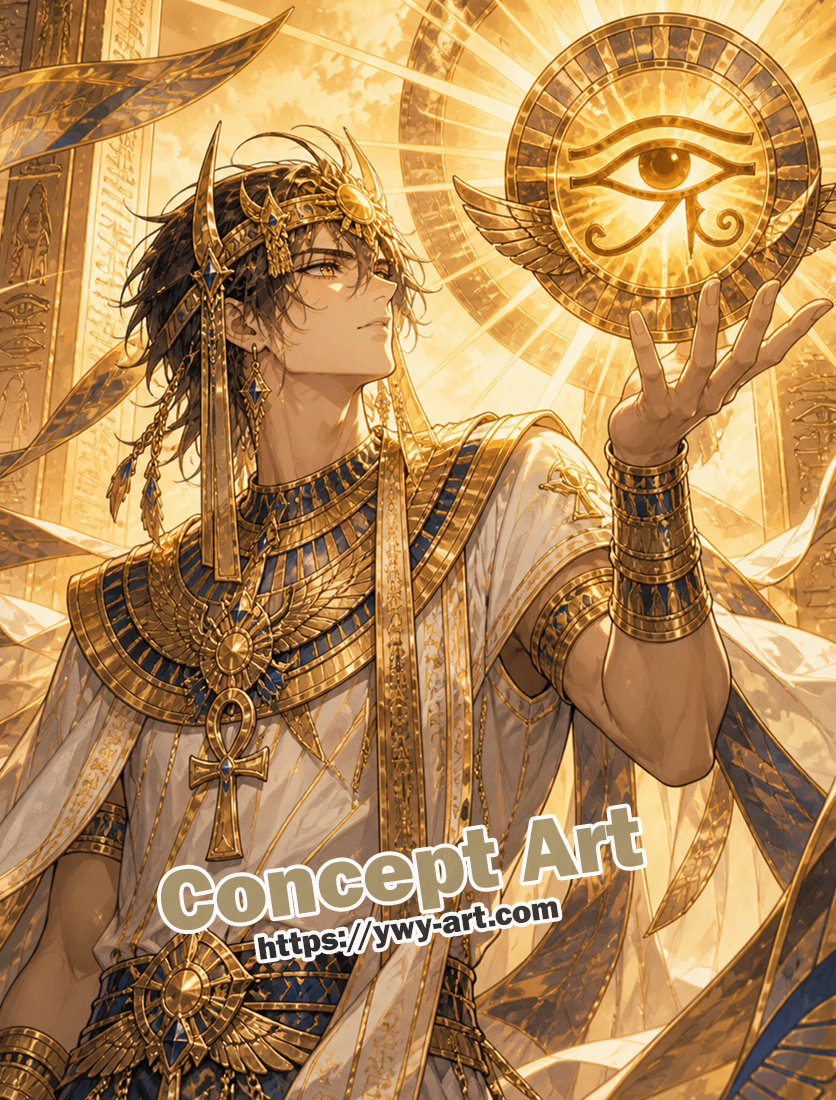
Ra Solar Eye Disk
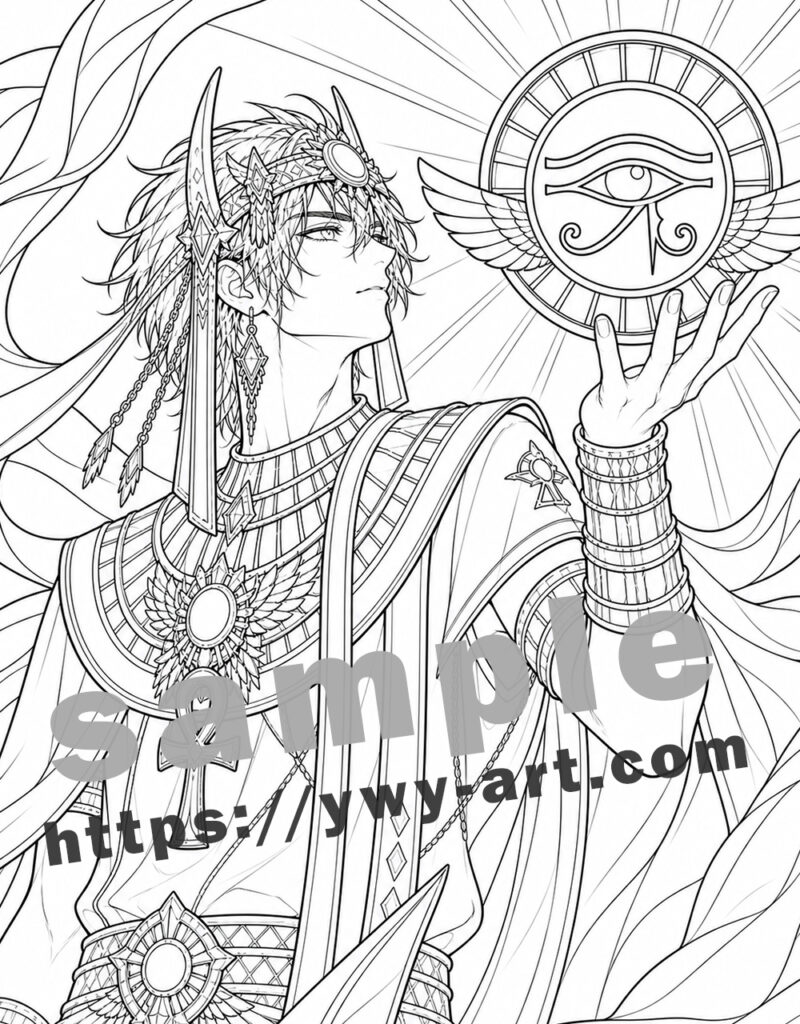
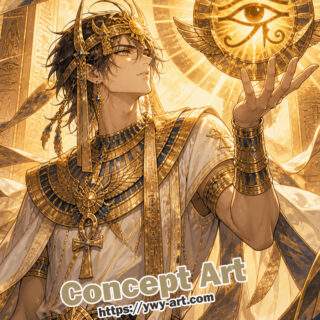
Ra is not just a god who represents the sun. He is the daily rising of light, the power that makes life possible, and one of the great divine forces behind Egyptian kingship and cosmic order. In this illustration, the Solar Eye Disk becomes the central artifact, glowing above his hand like a sacred sun made visible. It feels radiant and majestic, but honestly, there is something intense underneath all that gold. Ra’s light gives life, yes, but it also sees, judges, burns, and protects.
Basic Profile
| Name | Ra |
|---|---|
| Mythology | Egyptian Mythology |
| Gender | Male |
| Region | Ancient Egypt, especially Heliopolis, temples of the sun, royal ideology, and the celestial journey of the sun |
| Era | Ancient Egyptian religious tradition, especially prominent from the Old Kingdom onward |
| Domain | Sun, creation, kingship, light, cosmic order, protection, daily renewal |
| Symbol | Solar disk, Eye of Ra, falcon head, sun boat, scarab, uraeus, winged sun |
| Culture / Religion | Ancient Egyptian religion |
| Main Role | Sun god and creator figure whose daily journey sustains the world |
| Associated Deity | Horus, Atum, Amun, Hathor, Sekhmet, Bastet, Khepri, Osiris, Apophis |
| Common Depiction | A falcon-headed or radiant solar deity crowned with the sun disk, often connected with the sun boat and royal power |
| Alignment | Radiant, sovereign, creative, protective, severe, life-giving, and impossible to ignore |
Overview
Ra is one of the most important gods in ancient Egyptian religion. He is the sun in its divine form, but his role goes beyond simple daylight. The sun was the great visible force that returned every morning, crossed the sky, disappeared into the west, and was reborn again. That daily rhythm gave Ra a deep connection to creation, renewal, order, and the stability of the cosmos.
In Egyptian thought, the world depends on balance. Darkness, chaos, and disorder are always present as threats, but each sunrise proves that order can return. Ra’s journey across the sky is therefore not just a natural event. It is a sacred victory repeated every day. The sun rises, and the world continues.
Ra is also closely connected with kingship. Egyptian pharaohs were often described as sons of Ra, and solar imagery became deeply tied to royal authority. This makes sense visually and politically. The sun sees everything, shines above everything, and gives life to everything below. A king linked to Ra receives a share of that cosmic legitimacy.
In this artwork, the Solar Eye Disk gathers those meanings into one artifact. The disk shines with golden rays, an eye at its center, and wing-like forms that suggest divine protection. Ra holds it not like a weapon, but like a sacred authority. Still, the object feels powerful enough to command the whole scene.
The Artifact: Solar Eye Disk
The Solar Eye Disk is a creative artifact built from two major Egyptian symbols: the solar disk and the Eye of Ra. The solar disk represents the sun’s divine body, the visible light of Ra moving through the sky. The Eye of Ra, however, adds a sharper and more active meaning. It is not only sight. It is protection, wrath, power, and the extension of Ra’s will.
The Eye of Ra can appear through several goddesses, including Hathor, Sekhmet, Bastet, and others depending on the mythic context. This eye can protect the sun god, attack his enemies, and punish rebellion against cosmic order. That makes the artifact more intense than a peaceful sun ornament. It is light with agency.
The disk in this illustration feels almost like a floating divine seal. The eye at the center suggests watchfulness. The wings suggest protection and movement across the sky. The golden rays turn the artifact into a small sun, concentrated and held in Ra’s hand. It feels ceremonial, but not passive.
A solar disk is circular, which naturally suggests completion, cycles, and return. Every day, the sun completes its path and begins again. The Solar Eye Disk therefore carries the idea of endless renewal. But the eye inside the circle changes the mood. It tells us that this renewal is watched over, defended, and judged.
Mythological Background
Ra appears in many forms and combinations across Egyptian religion. He can be linked with Atum as Atum-Ra, emphasizing creation and the setting sun. He can be joined with Amun as Amun-Ra, a powerful form especially important in later religious development. He can also be associated with Horus through solar and royal imagery. Egyptian gods often overlap in this way, forming layered divine identities rather than fixed separate categories.
One of Ra’s most important mythic patterns is his daily journey. By day, he travels across the sky in the solar boat. By night, he passes through the underworld, facing dangers before being reborn at dawn. This journey is not easy. Each night, Ra must confront the serpent Apophis, a force of chaos that tries to stop the sun and break the order of the world.
This battle against Apophis gives Ra’s sunlight a stronger meaning. Daylight is not just pretty brightness. It is the result of cosmic struggle. The sunrise means chaos has been pushed back again. That gives the Solar Eye Disk a powerful narrative role: it is the light that survives darkness.
The Eye of Ra also appears in myths where Ra sends his eye to punish humanity or restore order. In some traditions, the eye takes the form of Sekhmet, whose wrath becomes so destructive that she nearly wipes out humankind. This story shows the dangerous side of solar power. The same divine force that sustains life can become overwhelming if released without restraint.
Ra’s connection to creation is equally important. In Heliopolitan theology, Atum-Ra is connected with the emergence of the first gods and the ordering of the world from primordial waters. This makes Ra not only a sky traveler, but a creator force whose light helps define existence itself.
Symbolism and Meaning
The Solar Eye Disk represents divine sight. The eye sees what is hidden, watches over order, and reveals what darkness tries to cover. In this sense, Ra’s power is not only heat and light. It is awareness. Nothing can fully hide from the sun.
The disk also symbolizes renewal. Every sunrise is a return from danger. The sun disappears, travels through darkness, and comes back. That pattern makes Ra a symbol of endurance and rebirth. The world may fall into night, but light has a path back.
The winged form of the disk can be read as protection. In Egyptian art, winged sun imagery often suggests divine shelter and royal power. The wings extend outward, almost like the light itself is guarding the space below. That gives the artifact a strong temple-like feeling.
The golden color matters too. Gold was strongly associated with the divine in ancient Egypt because it does not tarnish easily and shines like the sun. A golden solar artifact therefore feels eternal, not temporary. It is not just bright. It is incorruptible.
The eye at the center adds severity. Without the eye, the disk might feel purely warm and radiant. With the eye, it becomes conscious. It looks back. That is what gives the image its stronger presence. Ra’s light is not anonymous sunlight. It is the gaze of a god.
Coloring Notes
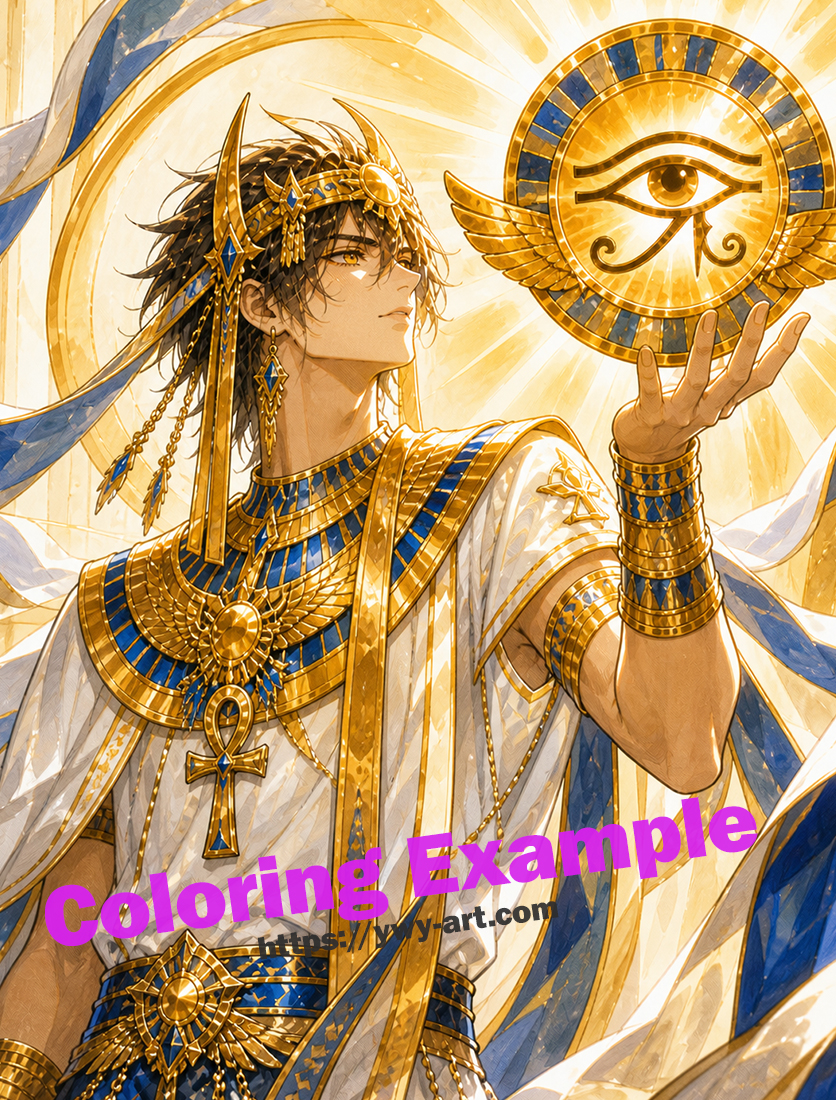
This page works best with a radiant Egyptian palette. Gold, deep blue, ivory, white, amber, warm sand, and small touches of black can create a strong solar-temple atmosphere. The Solar Eye Disk should remain the brightest point, so its rays and central eye need the strongest contrast.
For the disk, use layered gold tones rather than one flat yellow. Pale yellow can sit at the brightest center, with golden orange, ochre, and bronze around the outer rings. This will make the disk feel luminous and metallic at the same time.
The eye itself can be colored with strong contrast. Black or dark brown for the pupil, warm gold around the iris, and white or pale cream highlights will make it immediately readable. If there are blue accents, lapis blue works beautifully with Egyptian gold.
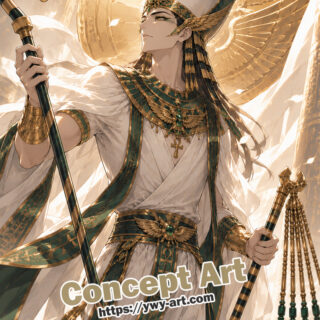
Ra’s clothing can use white, cream, and gold, with deep blue accents for collars, cuffs, and ornaments. White fabric will make the golden light feel stronger. If the whole figure becomes too yellow, the image may flatten, so blue shadows and soft gray folds are useful.
The background can stay warm and bright, but not equally intense everywhere. Pale sand, soft gold, and temple-like shadows will support the artifact. The strongest glow should remain behind and around the Solar Eye Disk, so the viewer’s eye moves naturally toward the symbol of Ra’s power.
Quick Creative Reference
| Element | Creative Direction |
|---|---|
| Best For | Egyptian solar mythology, divine kingship, creation themes, sacred light, temple imagery |
| Visual Keywords | Ra, Solar Eye Disk, Eye of Ra, sun disk, golden rays, wings, ankh, royal light |
| Mood | Radiant, majestic, sacred, protective, severe, life-giving |
| Recommended Colors | Gold, amber, ivory, white, lapis blue, warm sand, bronze, black accents |
| Main Focus | The Solar Eye Disk as a symbol of divine sight, solar renewal, protection, and cosmic order |
| Coloring Tip | Keep the brightest gold and sharpest contrast around the central eye so the disk feels both radiant and watchful. |
Compare with Similar Deities
| Name | Mythology | Main Domains | Overall Image |
|---|---|---|---|
| Ra | Egyptian | Sun, creation, kingship, cosmic order, daily renewal | A supreme solar god whose light sustains the world and protects order from chaos |
| Horus | Egyptian | Kingship, sky, protection, royal power, divine sight | A falcon god of kingship and the sky, closely tied to the Eye of Horus and royal legitimacy |
| Helios | Greek | Sun, solar chariot, daylight, witness | A direct personification of the sun who travels across the sky and sees all from above |
| Apollo | Greek | Music, prophecy, healing, archery, later solar light | A radiant god of harmony and clarity, later associated with sunlight but less directly solar than Ra |
Closing
Ra Solar Eye Disk is a strong artifact piece because it turns sunlight into divine authority. The disk is not just bright. It watches, protects, renews, and burns away disorder. Ra’s power is beautiful, but it is not gentle in a simple way. Every sunrise in his mythology is a victory over darkness, and the Solar Eye Disk carries that victory in one blazing symbol.
Step into the world of mythology..
Available on Amazon Mythology Artifacts Series: Symbols of Power Coloring Book Open in a new tab






コメント